
As more Japanese climate tech startups look to scale internationally, a familiar question keeps coming up: what actually breaks when you leave a mature home market?
Working alongside JETRO, Third Derivative, and Japan Energy Fund to support a cohort of Japanese founders exploring expansion into the US and Southeast Asia, a set of consistent patterns emerged — not from pitch decks, but from real market conversations with investors, corporates, and partners.
Across the Global Startup Accelerator Program (GSAP), founders kept running into the same friction points.
The first was translation.
Technologies that were technically sound and well-received in Japan often landed very differently overseas. Partners pushed for clearer commercial logic, tighter value propositions, and more direct answers to who the customer really is and how buying decisions get made.
Then came speed.
Markets like the US, Singapore, and Thailand move fast and expect iteration. Long timelines and carefully sequenced pilots were less persuasive than momentum and learning-by-doing. That tension surfaced gaps early — and forced sharper prioritisation.
Finally, trust.
Successful market entry hinged less on pricing models and more on relationships, local credibility, and understanding informal power structures that rarely show up in market reports.
Participating startups
The selected startups represent cutting-edge innovation across climate and energy sectors — aligned with the growing global demand for scalable decarbonization solutions.
Throughout the program, they engaged in:
- Go-to-market workshops focused on U.S. and Southeast Asian expansion
- One-on-one mentorship with industry leaders and climate investors
- Commercial partner introductions and strategic advisory support
- A one-week U.S. immersion, including exhibition at VERGE and investor pitch sessions, which attracted over 100 participants, from investors, corporates, and local startups.
1. Aqua Theon: Seaweed-based biomaterials for food, packaging, and medical applications.
2. Atierra: CO₂ removal via microalgae bioreactors—turning emissions into biomass and bioactive ingredients.
3. E-ThermoGentek: Converts industrial waste heat into electricity using thermoelectric technology.
4. Elephantech Inc.:Metal-inkjet printed PCBs offering low-waste, rapid-iteration electronics manufacturing.
5. Emulsion Flow Technologies: Solvent-extraction system for recovering rare metals—especially cobalt and PFAS—from wastewaters.
6. Helical Fusion: developing steady-state fusion reactors for scalable clean power.
7. Miibio, Inc: Light-switchable protein tech for precision biomanufacturing—fermentation, reagents, and biosensors.
8. Planet Savers, Inc: Developing a scalable DAC system using proprietary CO₂ adsorbent technology.
9. Rhinoflux Inc.: Converts biomass to energy while capturing CO₂—integrating bioenergy and carbon sequestration. (Kyoto University spin-out)
10. Sun Metalon Inc.: Metal recycling with integrated CO₂ reduction, targeting industrial waste streams.
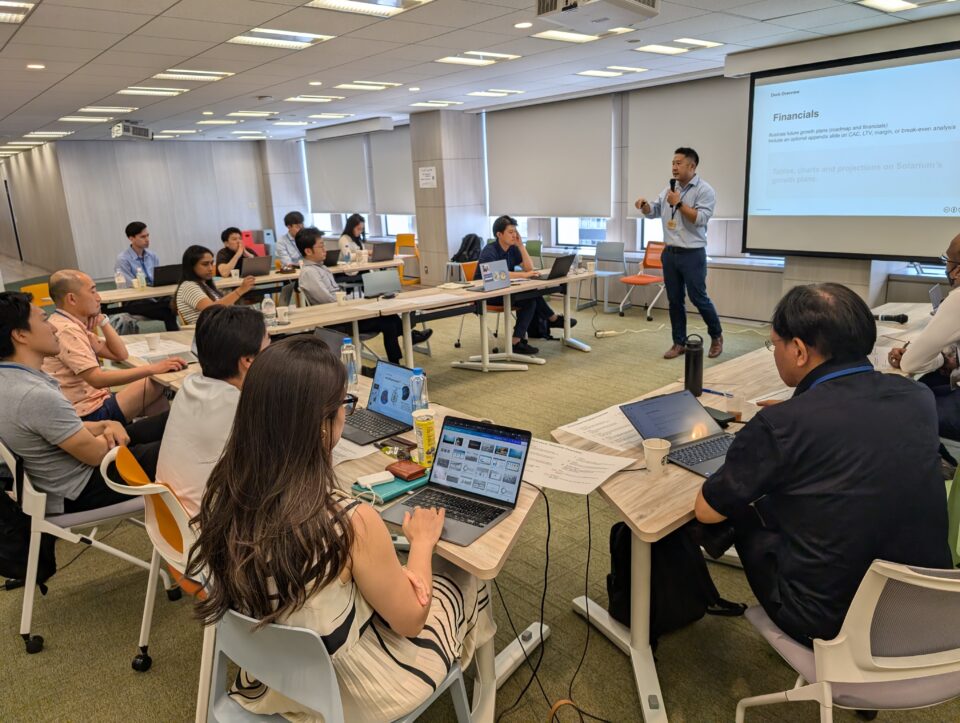
New Energy Nexus CEO Andrew Chang speaks to the GSAP participants.
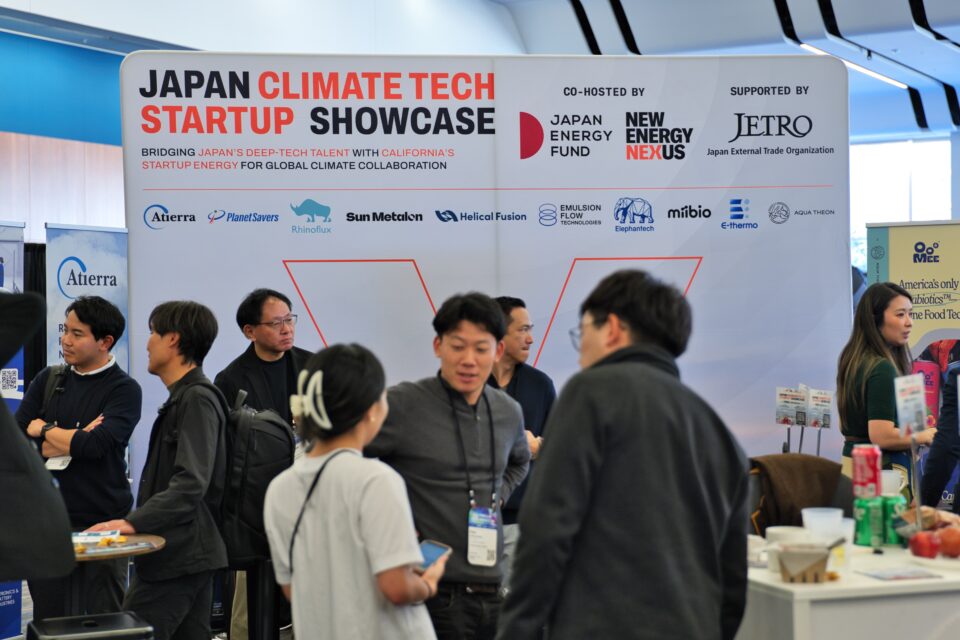
The Japan Climate Tech Startup Showcase at VERGE 2025 in San Jose, California.
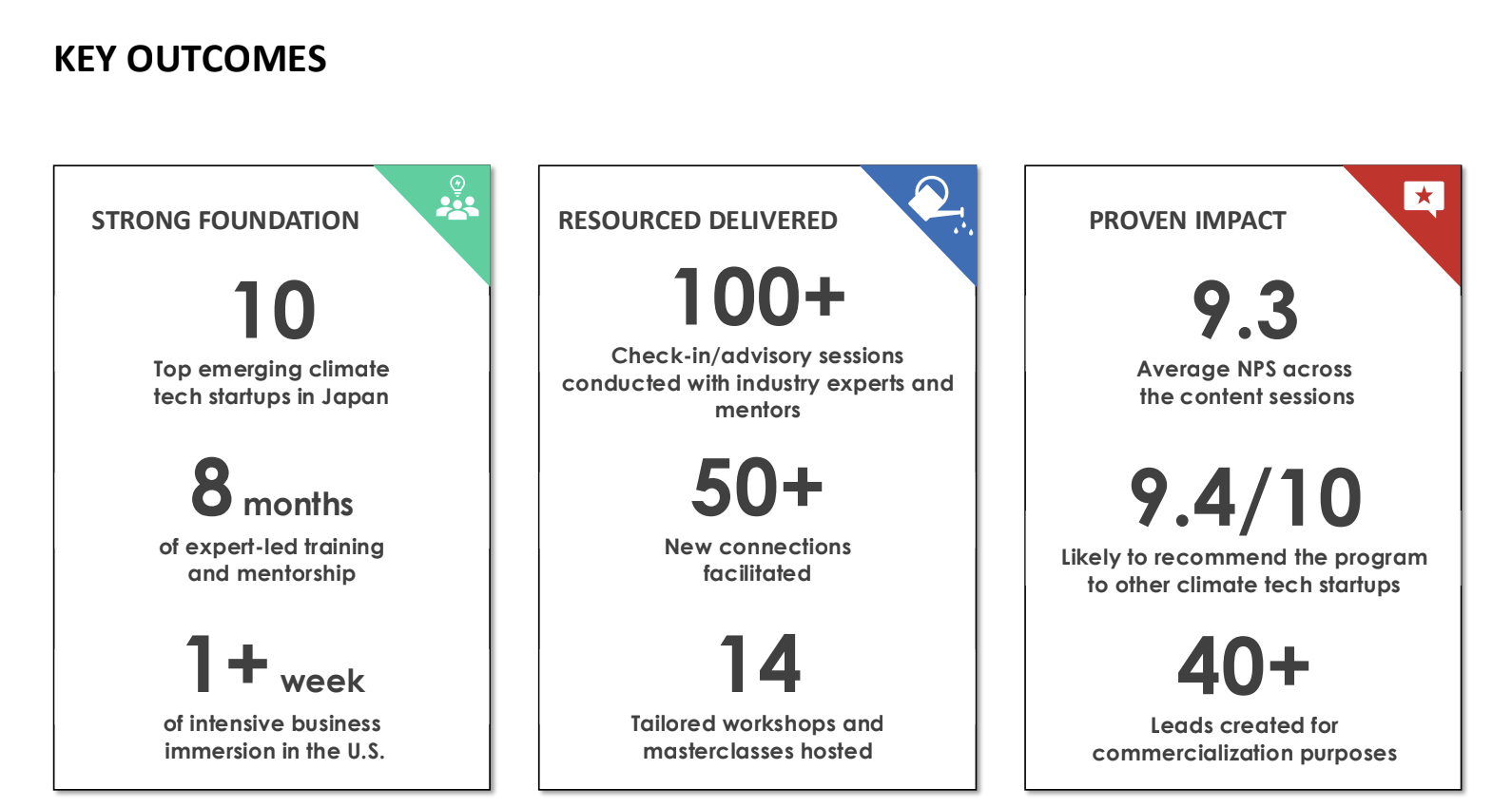
Looking ahead
As climate challenges intensify, cross-border collaboration is essential to accelerate innovation and deployment. This program marks not an endpoint, but the beginning of sustained international engagement for Japan’s next generation of climate tech leaders.
If you are interested in this initiative or exploring collaboration opportunities, we would be happy to connect. Please contact japan@newenergynexus.com