
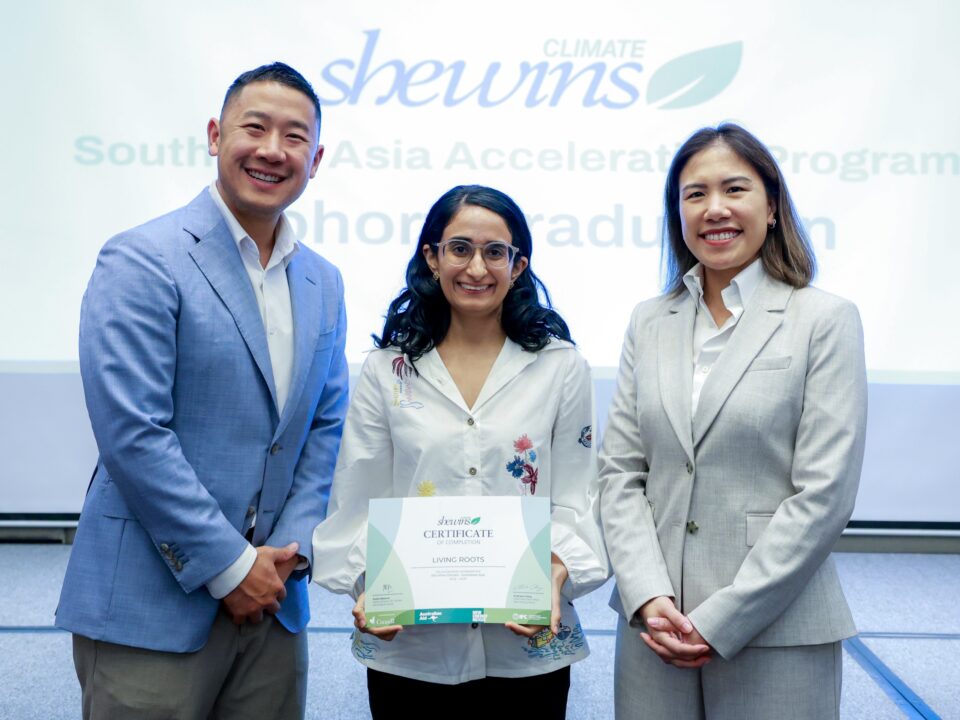
Andrew Chang, CEO of New Energy Nexus (left), and EAP Lead Program Officer at World Bank Group, Vicky Tsang (right), pictured with Avika Narula, CEO of Living Roots (center).
The She Wins Climate Southeast Asia Accelerator reached a critical milestone in Bangkok, (March 27, 2026) where its cohort of women-led climate startups came together for the program’s Graduation and Investment Summit. The event recognized the dedication of participants to growing their businesses, while focusing on what comes next: connecting founders with capital, and converting progress into opportunity.
Across Southeast Asia, climate innovation is accelerating, but access to capital remains uneven, particularly for women founders.
The summit placed that gap at the center of the conversation, bringing together development partners, investors, and entrepreneurs to align around a shared priority, to build a pipeline that is not only visible, but also investable.
Led by the International Finance Corporation in partnership with New Energy Nexus, She Wins Climate has worked over the past six months with 25 startups from across the region. These startups span renewable energy, circular economy, agriculture, water, and climate adaptation, sectors that are increasingly central to Southeast Asia’s growth trajectory.
At the summit, the message from participating partners was consistent. The opportunity is already here, but systems need to respond differently.
Yuan (Jane) Xu, Country Manager for Thailand and Myanmar at the International Finance Corporation, framed the conversation in economic terms.
“Removing barriers to women’s economic participation can increase national output by 15 to 20 percent. That is not a social statistic. That is an economic one,” said Yuan (Jane) Xu, Country Manager, Thailand and Myanmar, IFC.
She also pointed to a longer-term structural challenge shaping the region.
“Over the next 10 to 15 years, 1.2 billion young people will reach working age, yet only about 400 million jobs are expected. This gap will not be closed without unlocking the full potential of women.”
Her remarks underscored a shift in framing. Women-led climate startups are not a niche segment. They are part of the solution to both economic growth and job creation.
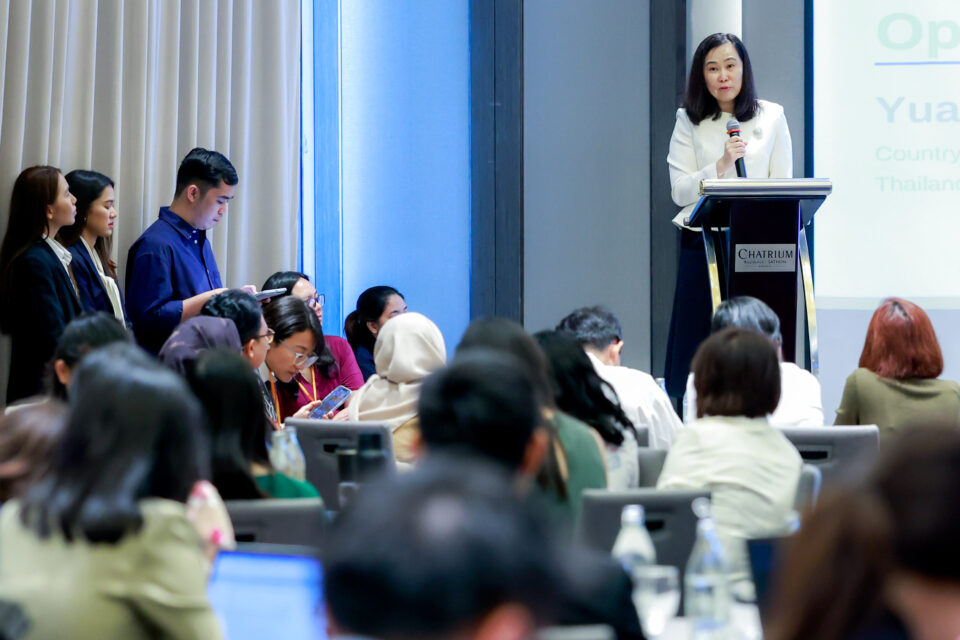
Opening remarks by Yuan (Jane) Xu, IFC Country Manager for Thailand and Myanmar, during The She Wins Climate Southeast Asia forum.
From a financing perspective, Matt Kellam of the Australian Department of Foreign Affairs and Trade highlighted how blended finance is being used to bridge persistent gaps.
“Women entrepreneurs are more likely to start sustainability-focused businesses and drive innovation, yet lack of access to finance continues to limit their role in just transitions,” said Matt Kellam, Blended Finance Unit, Department of Foreign Affairs and Trade.
Australia’s approach, he noted, focuses on mobilizing private capital into sectors that deliver both climate and gender outcomes, while strengthening the pipeline of investable businesses.
That pipeline is exactly where programs like She Wins Climate play a role. Frank Le, Counsellor and Senior Trade Commissioner at Global Affairs Canada, emphasized the importance of pairing funding with ecosystem support.
“Programs like She Wins Climate equip women entrepreneurs with the capacity, networks, and investment readiness needed to scale, strengthening their access to finance and positioning them to lead in climate solutions,” said Frank Le, Counsellor and Senior Trade Commissioner, Embassy of Canada to Thailand.
At the program level, the gap is clear. While global climate investment continues to grow, only a small share reaches female-led ventures, particularly in emerging markets. As Chi Nguyen, Program Officer at the International Finance Corporation, put it:
“The gap is not in the solutions. The women founders in this room are already building and delivering. The gap is in where the money is going,” said Chi Nguyen, Program Officer, IFC.
The Southeast Asia cohort reflects that reality. The 25 startups represent seven countries and bring a mix of technical, operational, and market expertise. Many are already working with smallholder farmers, SMEs, and climate-vulnerable communities, demonstrating models that are both scalable and grounded in local contexts.
The graduation ceremony marked the end of the accelerator phase, but the focus of the summit quickly shifted toward engagement. A panel discussion brought together investors, founders, and ecosystem players to unpack what drives investment decisions in the region and how gender-lens investing can move from intention to practice.
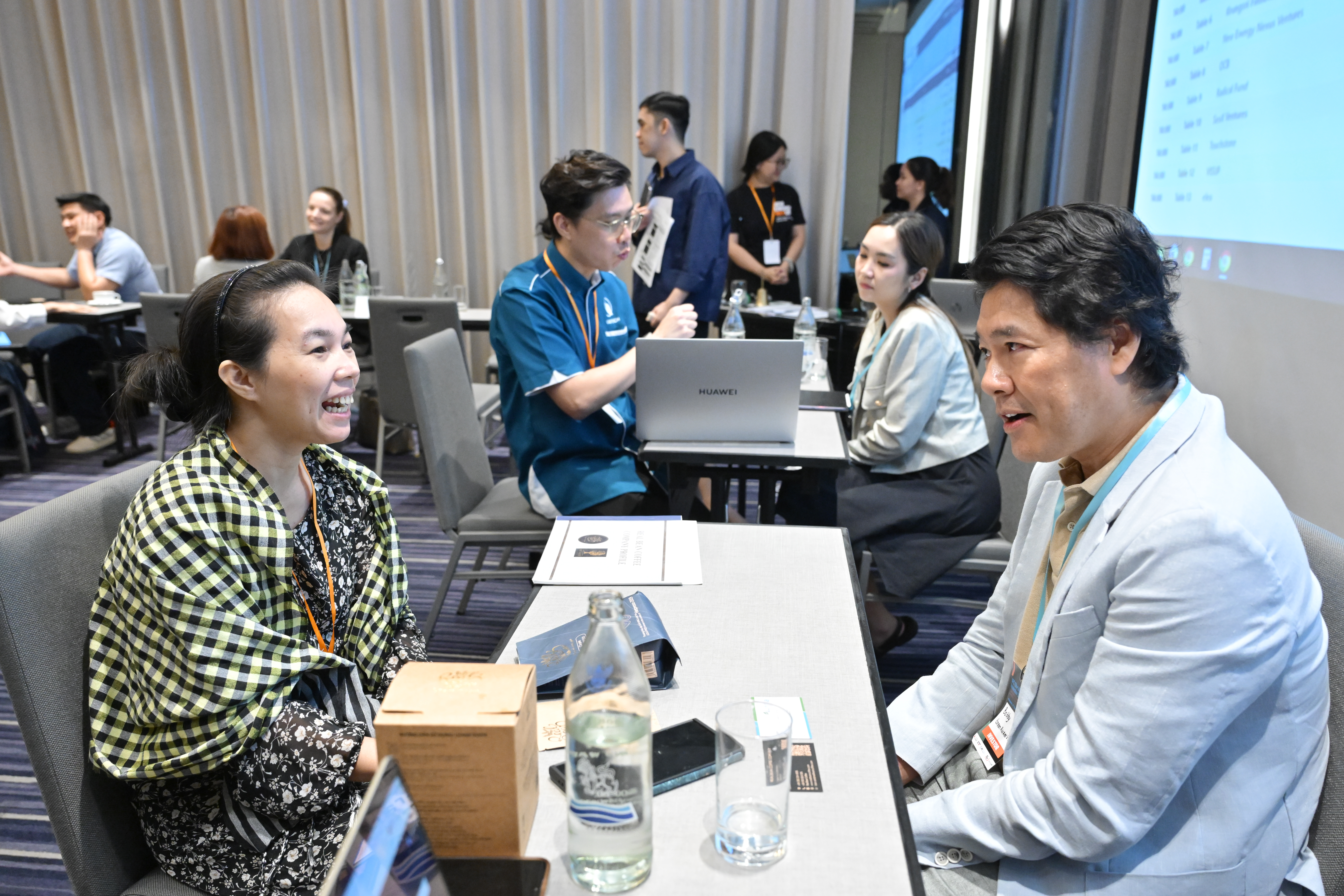
The atmosphere of the investor speed dating session, where founders have the opportunity to engage in deep discussions with global investors. This session serves as a strategic space to align growth visions and capital needs within an increasingly competitive climate investment landscape.
The most direct interaction came through the investor speed dating sessions, where founders engaged with 13 investors, including VISUP, A2D Ventures, Touchstone, elea, SeaX Ventures, New Energy Nexus Ventures, Beacon Venture Capital, GreenRocketVC, Krungsri Finnovate, Radical Fund, GroFin, and OCB.
These sessions were designed to move beyond visibility, creating space for real conversations around fit, growth, and capital needs. For founders, it was an opportunity to position their businesses within an increasingly competitive climate investment landscape. For investors, it offered access to a curated pipeline of ventures that have already undergone rigorous preparation.
What emerged from the summit is a clearer picture of where the ecosystem stands. The pipeline of women-led climate startups in Southeast Asia is no longer the constraint. It is growing, diverse, and increasingly investment-ready.
The challenge now sits with capital, how quickly it can adapt, and whether it is willing to recognize the opportunity in front of it.
Because as the summit made clear, this is no longer about proving that women-led climate solutions exist.
It is about whether the system is ready to back them at scale.
Find out more about the She Wins Climate Southeast Asia Accelerator here.