Story
Women
Empowering more women-led climate entrepreneurs in Southeast Asia – NEX virtual meet up

20191123 101517

Women-founded and led startups are receiving more attention in Southeast Asia, but they still represent a very small fraction. This is the focus of a webinar bringing together entrepreneurs and experts at Women Empowerment in Southeast Asia’s Clean Energy Economy virtual meetup on 9 March, one day after International Women’s Day.

The situation in Southeast Asia reflects a global trend: only 20% of global startups are led by women (2019), while women represent only 32% of the workforce in the renewable energy sector. Exploring the barriers to women-led climate entrepreneurship, as well as the support up-and-coming women entrepreneurs can tap into will be crucial to ensure the benefits of clean energy and climate solutions are distributed more equitably and sustainably.

Hosted by New Energy Nexus, the panel of speakers includes representatives from startups, supporting organizations, and venture capital: 

  • Chi Trinh is the Vietnam Country Manager of Clime Capital. Clime Capital identifies and creates investment opportunities founded on long-term, stable cash flow assets that contribute towards reducing climate change impacts, alleviating infrastructure gaps, and building sustainable economies.
  • Laurie B. Navarro is the President of CSi Energy Solutions International. CSi is a consulting company on energy and environment based in the Philippines and providing services in the region. 
  • Maaike Doyer is founder of Epic Angels – a network of female executives and operators who have built and expanded multiple companies in all parts of the world. Epic Angels has the ambition to become the largest female-only angel network in Asia. 
  • Mada Ayu Habsari is Managing Director of PT. Enertec Mitra Solusi – a women-led startup based in Indonesia that is focusing on energy service, energy efficiency, and renewable energy. Enertec started its journey as an energy services company with the focus of providing energy efficiency solutions on existing buildings and retrofit public facilities.
  • Phattanan Supasatian, Chief Executive Officer, Godung Faifaa – a new online market that collects complete solar system equipment.
  • Stanley Ng is the Southeast Asia Program Director at New Energy Nexus – an international nonprofit that supports diverse clean energy entrepreneurs with funds, accelerators, and networks.

Topics covered in the virtual meet up:

  1. Opportunities and challenges for women-led clean energy and climate startups and enterprises
  2. Perspective on the performance of women-led clean energy and climate startups and enterprises
  3. Supports available from the community for clean energy and climate female founders, entrepreneurs, and innovators

​Register at: https://bit.ly/WomenEmpowerment22 

About New Energy Nexus:

New Energy Nexus (NEX) is an international nonprofit supporting diverse climate entrepreneurs to accelerate the transition to 100% clean energy for 100% of the population. New Energy Nexus provides funds, accelerators and networks, with initiatives in China, India, Indonesia, Nigeria, the Philippines, Singapore, Thailand, Vietnam, Uganda and the USA.

Media contact: Tristan Tremschnig, Global Communications Director, New Energy Nexus, tristan.tremschnig@newenergynexus.com (based in Hong Kong)
Explore More
Story
Indonesia
Women
Empowering women with renewable energy in Indonesia

rambu yati

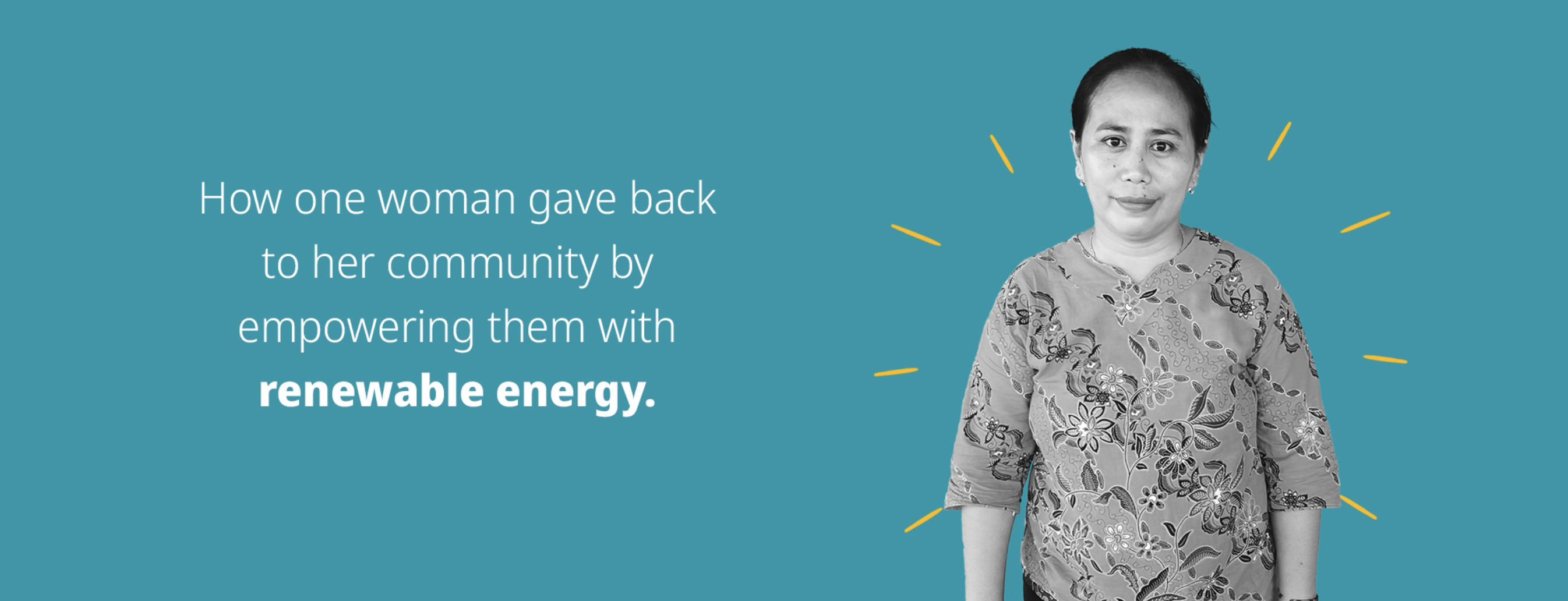
Rambu Yati Radandima, a finance manager in Indonesian start-up Sumba Sustainable Solutions (3S), is giving back to her community. A start-up with a focus on inclusive and sustainable innovations in Sumba Island, 3S provides local schools, villages and community health centres with access to solar power.

Rambu Yati’s work has personal meaning. She knows what it’s like to live without reliable access to electricity. Sumba, an island in the East Nusa Tenggara Province of Indonesia, has a unique geographical character that makes tapping into the national electricity grid difficult. In the past, over 500,000 families living there—roughly 38% of the island’s population—struggled with little or no electricity.

Rambu Yati says: “Life in the village was very different. Back in the 90s, my family relied on kerosene lamps to light up our home when we cooked or when we wove palm mats. We had to manually pound rice and corns because we had no access to milling machines.”

While the Indonesian government committed to electrifying the entire country by 2020 (RUEN 2017)[1], only 62% of the East Nusa Tenggara population has access to electricity, the lowest energy access level in Indonesia (IESR, 2019).

Stepping stones

In 2000, Rambu Yati enrolled in the Warmadewa University in Bali. She successfully graduated with an undergraduate degree in Agricultural Science. Today, as finance manager at 3S, Rambu Yati is involved in solving energy access issues in her community by providing solar-powered technologies to local institutions. An ethical, profitable business, 3S’s work focuses on bridging the energy gap in rural communities.

The distribution of solar-powered lighting solutions has significantly improved Rambu Yati’s community. Today, Sumba’s children can finally do their homework and study at night. Power has also improved people’s livelihoods, allowing more hours for local artisans to weave tenun ikat, a traditional handwoven fabric. Unique to Sumba, tenun ikat is part of Indonesia’s artistic heritage.

Mission for productivity

3S also provides solar systems for people’s homes and solar-powered productivity centres, which are energy hubs for the community. These solutions are powering livelihoods in Sumba by enabling villagers to mill crops and process bamboo. They are not only making people’s livelihoods more sustainable but are also improving the quality of life for many women in Sumba.

Before, women had to spend several hours a day pounding corn and were left with just half a day free. The solar-powered productivity centres enable villagers to make better use of their time. The men take corn to the mill while the women shell candlenut, which they can later sell at a higher price.

Renewable energy is also saving money and improving people’s health. According to the Indonesian Central Agency of Statistics, villagers typically spend 10% of their monthly living costs on expensive fossil-fuel-based lighting, like kerosene lamps, which emit harmful fumes that can damage the lungs.

With solar-power solutions, Sumba’s villagers now have a greatly reduced electricity bill. Rambu Ina is one of 3S’s local customers. She says: “In the past, we only used the kerosene candle for one hour because it was too expensive. In the evenings, now I have light for four or more hours. At night, often we sit around and talk to our neighbours while shelling our candlenuts or working on woven palm mats to be sold at the market.”

Work in progress

Rambu Yati aspires to keep helping Sumba’s local communities to access renewable energy, so they can increase their incomes and afford a better education for their children. Ensuring 3S has operational and financial sustainability is crucial so they can maintain the solar home systems and solar-powered productivity centres that the villagers depend on.

Like many other start-up employees, Rambu Yati struggled with data collection and creating a balance sheet that was fundamental to 3S’s growth. That’s where New Energy Nexus stepped in.

New Energy Nexus connected Rambu Yati and her colleagues to experts in HR, marketing communications and finance, through a programme called Mentor-in-Residence. Thanks to this programme, Rambu Yati now has the essential resources and skills to move forward. She can confidently draft financial forecasts to determine what the start-up needs to scale up, and ultimately, empower more villages with renewable energy.

3S is no longer a start-up struggling to survive but a sustainable business instilled with a healthy company culture that upholds transparency and communications between team members and stakeholders. And the skills Rambu Yati has learned in areas like communications are helping her nurture a new generation of skilled workers on the island.

She says: “Before we started with the New Energy Nexus accelerator, we were just dealing with problems as they came up, feeling like there must a better way. With New Energy Nexus’ guidance, we now have a clear plan for all parts of the business and our whole team is committed to achieving the goals that we have set together.

“I feel that we now have a shared responsibility to make our company vision and mission—to empower rural communities through access to energy and appliances for productive use—a success.”

[1] Indonesia’s National Energy Plan (Rencana Umum Energi Nasional (RUEN)).

Explore More