Story
New York
Built Environment
10 energy storage startups to watch out for in our New York program’s latest cohort

Energy storage is critical to help us unlock the full potential of renewable energy. Without energy storage systems, we would not be able to affordably reach net-zero greenhouse gas emissions. It is a key step to enable low carbon systems that will help fight climate change and make affordable energy more accessible to everyone.

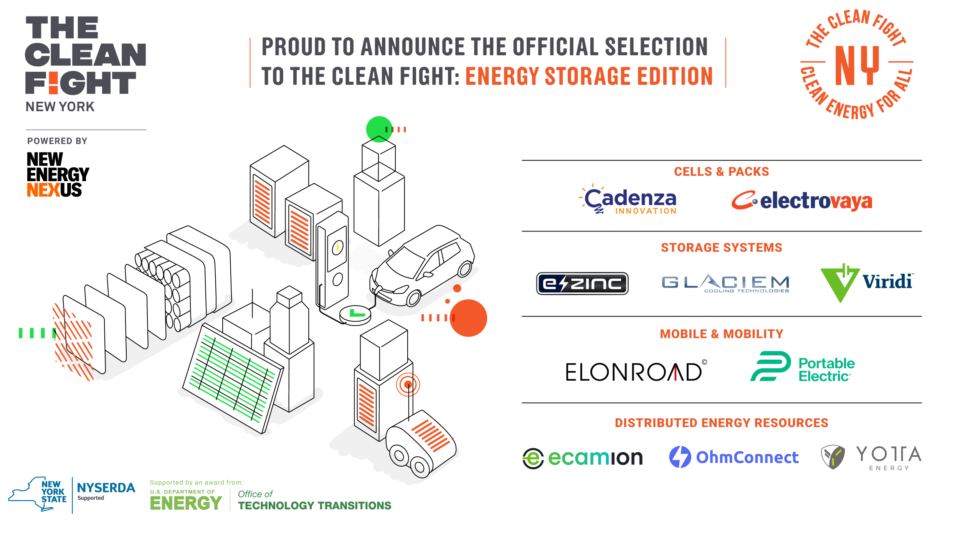
New York is increasingly becoming known as one of the global energy storage hubs in the world, thanks to Biden’s Build Back Better Plan that will invest billions into climate and clean energy among other select industries. Our New York Program, The Clean Fight that was recently selected to manage US$10M Empire Technology Prize to advance building decarbonization brings you ten growth-stage companies in the latest cohort to accelerate New York’s position as a U.S. hub for energy storage.

co hort3 selection announcement 03

The program will focus on battery and energy storage solutions, development and manufacturing. The goal is to help these companies to successfully and rapidly scale sales and manufacturing in New York. To facilitate this, each of the selected companies is eligible for:

  • a range of tailored benefits, valued at up to $100,000 per company to support capacity building, deployments or manufacturing capabilities in New York;
  • hands-on matchmaking with industry leading customer and capital partners;
    bespoke support services; and
  • expert insight into navigating the New York State market.

Based in Europe, Australia and North America, and working across the value chain, listed below are the ten transformative companies. We’re excited to see how they work together and with our partners to aggressively advance the clean energy transition, while boosting economic opportunity and job creation for all.


Cells & Packs


2022 10 27 cadenza logo transp

Cadenza Innovation, based in Connecticut, makes novel battery packs designed to address one of the greatest concerns with Lithium-Ion batteries – fire prevention, making them safer, more reliable and affordable.


electrovayalogo

NY’s Electrovaya makes batteries with an exceptional combination of high energy density, safety and longevity, making them particularly well suited to heavy use vehicles such as electric trucks and buses.


Energy Storage Systems

e zinc

Toronto’s e-Zinc makes battery cells that store electrical energy within zinc metal, storing hundreds of hours of energy at a significantly lower cost. This can dramatically improve the value proposition of intermittent electricity such as wind and solar.


glaciem logo

Based in Australia, Glaciem Cooling’s heat pump technology provides heating and cooling to commercial and industrial customers, combined with a phase change thermal battery to provide integrated energy storage, for improved efficiency and cost.


viridi logo blue horizontal 01 01 01

Buffalo, NY based Viridi designs and builds distributed energy storage systems that are affordable, scalable and safe enough for use in occupied buildings, providing on-demand power for industrial, medical, commercial and residential applications.


Mobile & Mobility Systems

elonroad logobl 1000

Sweden’s Elonroad produces dynamic EV charging solutions embedded into roads, allowing for charging on the go. This also enables battery sizes to be reduced by up to 80%.


portableelectric

Portable Electric, based in Vancouver, makes portable, battery-based generators to replace gas and diesel generators, providing clean, silent power on demand. Their systems are used on job sites, for emergency EV and fleet charging, and as backup power.


Distributed Energy Resources

ecamion logo

Canadian company eCAMION delivers a Distributed Energy Resource solution for customers looking to manage batteries, solar installations, and EV chargers to maximize efficiency while minimizing cost and strain to the grid.


ohmconnect logo new

OhmConnect, based in California, builds Virtual Power Plants by connecting to residential batteries, EVs and smart thermostats, reacting in real time to the needs of the grid, reducing reliance on high-pollution peaker plants and lowering GHG emissions.


yotta energy logo horizontal full color

Austin, Texas based Yotta Energy produces distributed energy products, including EV chargers and the first solar battery that integrates behind rooftop solar panels. The integrated battery significantly reduces installation costs, along with its plug-and-play design that means if you can install a solar module, you can install their battery.

Learn more about our New York program, The Clean Fight designed to help the world’s best growth-stage startups significantly scale their business in New York State, while boosting economic opportunity and job creation for all. The Clean Fight is also a member of the winning New Energy New York coalition, who were awarded $113M as part of the Biden Administration’s Build Back Better Regional Challenge.

Explore More
Story
Energy Finance
4 ways climate fintech startups can ride the blockchain wave

The managing, trading, and financing of more and more distributed renewable projects, such as rooftop solar and EV charging stations, is becoming exponentially more complicated. Current energy systems and financing models are increasingly no longer fit for purpose, but this is creating new opportunities for climate fintech startups.

Blockchain technology, for instance, can help solve some of these problems given its transparency and immutability. Power grids, energy providers, and end users can use distributed ledgers via blockchain to track electricity generation and transaction records without a centralized organization in the middle. Financial institutions can also use blockchain to verify the operational data of the distributed renewable energy projects they have financed and decide their credit line, while minimizing the risks of operating miss and fraud.

So, how can startups best exploit this opportunity?

To answer this question, we first need to look at the ecosystem. Take a rooftop solar project, for example: there are many stakeholders in the value chain, including project owner, equipment supplier, financiers, and other service providers with different bargaining powers. As the end users, project owners usually have the greatest bargaining powers, but for distributed project owners, their bargaining powers aren’t as great as utility scale project owners.

Major equipment manufacturers have strong bargaining power as well, since the market is now dominated by just a few players. Among all solar equipment, the most relevant and important one that connects the physical world and the digital world is the inverter, a device that converts DC (direct current) to AC (alternating current), while recording electricity generation data. Top inverter manufacturers, such as Huawei and Sungrow, controlled 44% of the market share in 2021. Therefore, it’s natural for inverter manufacturers to develop blockchain solutions for downstream clients. Financial institutions are also key stakeholders in the value chain. However, they lack the adequate industry resources and knowhow, and rely on industry players as intermediaries, usually equipment suppliers, to develop businesses.

Given this competition landscape, what are the implications for climate fintech startups?

1. Startups need to define their value proposition in competing and cooperating with dominant equipment suppliers.

Even though inverter manufacturers might have some aspiration to develop blockchain technology by themselves, startups that focus on blockchain still hold a technological comparative advantage. Expanding their business to cover inverter suppliers is easier than inverter companies starting from zero. If startups can define themselves as an enabler and help inverter manufacturers complement their current business lines, they may avoid direct competition with these dominant equipment suppliers.

india solar

Dipole uses blockchain to make renewable energy more easily accessible across in Asia.


2. Target small and medium-size markets as an alternative strategy.

These markets are usually served by scattered small players who don’t have the right technology, abundant capital, or enough incentive to develop blockchain applications on their own. This gap could be filled by climate fintech startups. For instance, Dipole, a startup in New Energy Nexus China’s Excel Cohort, develops blockchain technologies and applications for distributed renewable energy projects, and has secured an investment from Jolywood, a medium-size solar equipment manufacturer. This has enabled this startup to access its investor’s market.

However, those with the most need sometimes cannot afford expensive technological solutions. The key for startups is to develop standardized products that are cost-efficient to attract small-size clients.

3. Partnering with financial institutions could be a long-term winning strategy for climate fintech startups.

Ready-to-use blockchain-based products from climate fintech startups will allow banks to enhance their due diligence and credit management processes. Compared with taking a one-time deal with assembly or inverter companies, long-term partnership with banks and other financial institutions is considered a superior choice. New Energy Nexus is actively helping climate finch startups, partner with leading green banks, such as China Industrial Bank.

4. Startups can leverage their position in other more fundamental and influential public blockchain projects.

Proactively joining public blockchain projects like the state backed Bit Factory project will entrench startups’ positions. Startups, especially for those at the scaling stage, should  make themselves the base (or a brick of the base) of the whole industry supply chain, instead of narrowing down to a single point. For example, by participating in the Bit Factory project, Rivtower, another startup supported by New Energy Nexus China, was able to attract investment from China Merchants Bank, and further extended its business into other climate finance projects.

Yafu Zhao is the Climate Fintech Lead at New Energy Nexus and is based in Shanghai, China.

Explore More
News
Australia
Transportation tech
New international initiative calls for more Australian startups to supercharge battery innovation

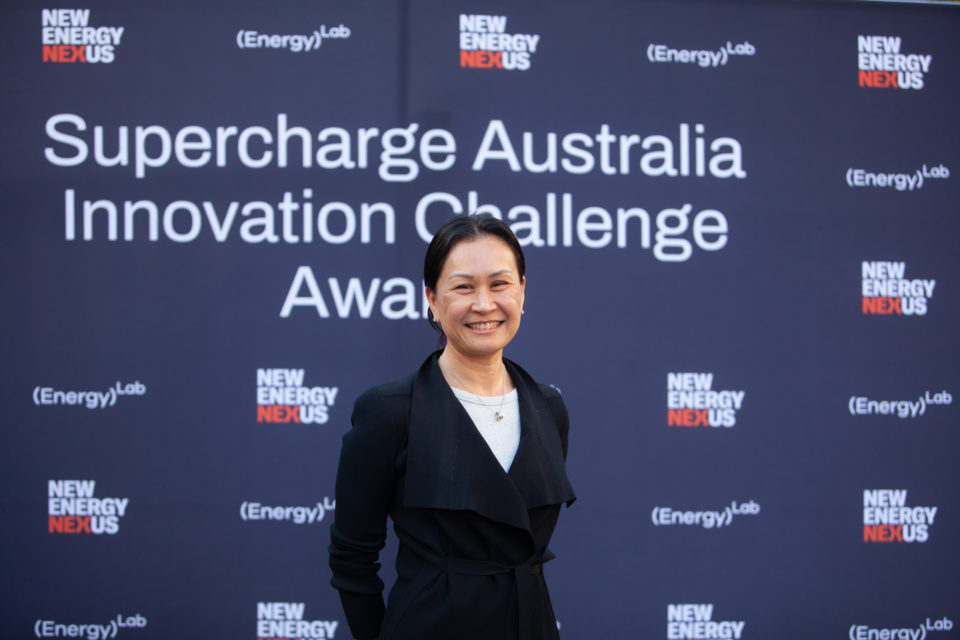
Sydney, 28 September 2022 – Supercharge Australia, a new initiative that aims to develop an ecosystem in Australia to support lithium battery innovation and capture more of the lithium value chain, launches today, backed by Boundless. This follows the recent Clean Energy Demand Initiative between the US and Australia, which aims to unlock  to unlock up to $US2.8 billion in funding for Australia’s clean energy sector, and the Australia–United States Net-Zero Technology Acceleration Partnership signed in July 2022. 

danny and megan 1 (3) edited

EnergyLab’s Megan Fisher (left) and NEX’s Danny Kennedy (right). Image: EnergyLab

Supercharge Australia is the first initiative of the recently announced partnership between global clean energy startup accelerator New Energy Nexus, and Australia and New Zealand’s largest climate tech startup accelerator EnergyLab.

Despite producing almost 60% of the world’s lithium, Australia retains less than 1% of the US$200 billion and rising annual product value, with 98% of the lithium mined in Australia being refined overseas.

“Australia can become a leader in lithium battery technology, from sourcing to advanced battery and EV manufacturing, and capture massive market opportunities as the world electrifies. But to do this, we need much more activity across all phases of the lithium battery value chain, and this requires more investment and more startups to meet the innovation challenge,” said Kirk McDonald, Project Manager of Supercharge Australia.

Supercharge Australia will bring the industry together to understand where innovation is required and leverage New Energy Nexus’ global expertise, including its role in the US Department of Energy’s Lithium Bridge project to accelerate the development of a robust and secure domestic supply chain for lithium-based batteries. EnergyLab’s Australian cleantech startup ecosystem experience and connections will be applied to establish a lithium battery  innovation challenge in early 2023, and to support Australian startups with expansion to international markets. Another critical element is ensuring Australia builds equity into the innovation ecosystem – recruiting diverse entrepreneurs and ensuring benefits flow to impacted communities and those traditionally excluded from the fossil fuel boom of last century.

There are already several startups in the Australian lithium battery value chain that are ready to scale [1].

ze photography

Kirk McDonald, Project Manager for Supercharge Australia at the Battery GigaFactories APAC conference in Perth, Australia.


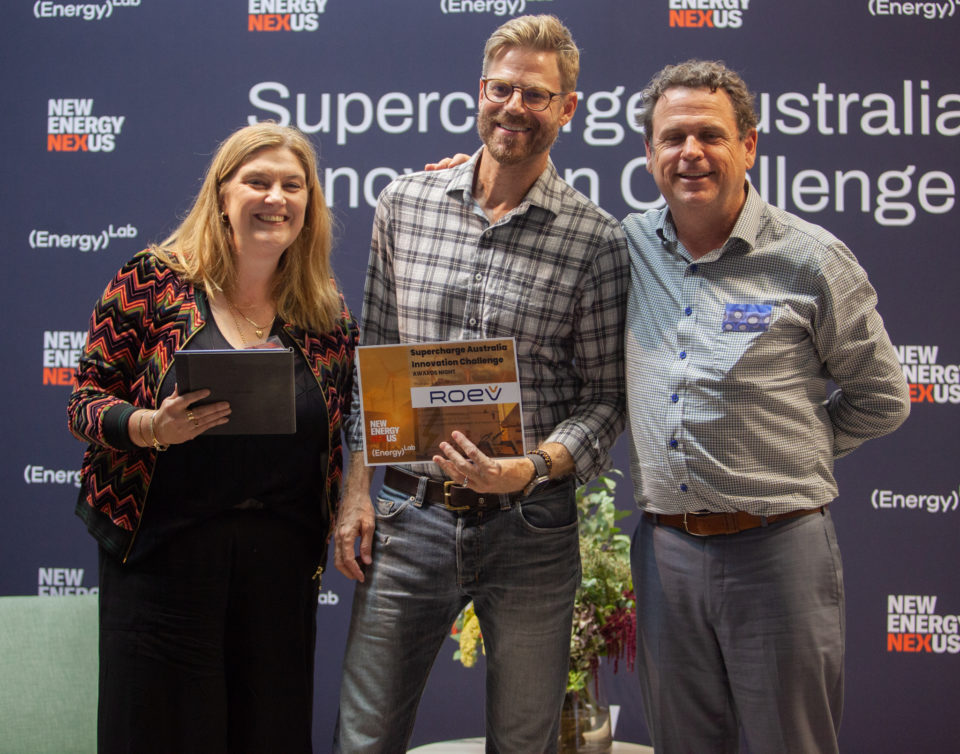
Roev is focused on providing energy-smart electric utes to Australia, with fully integrated conversions today and a locally built electric ute in the future. We support the work of Supercharge and see local battery supply as a key driver for sustainable growth in our business and the broader EV industry in Australia,” said Noah Wasmer, CEO of Roev

“EnergyLab has supported startups focused on clean energy and climate tech since 2017, Supercharge Australia means we can provide support and focus on the startups innovating in the lithium battery value chain. Australia is well positioned to capture the full value of the battery and electrification revolution. If you’re an aspiring founder, a startup, an investor, an expert, an industry player in this space and want to see growth supercharged then get involved,” said Megan Fisher, CEO EnergyLab.

“Supercharge will pave the groundwork for a battery manufacturing industry that Australia is well-placed to develop. An industry that can create quality jobs, income and carbon benefits for Australia,” said Eytan Lenko, CEO of Boundless.

“We call all Australian startups along the lithium battery value chain to massively grow Australia and the world’s most carbon-efficient and cost-effective lithium battery industry. If Australia can produce more throughout the lithium battery value chain, faster, cheaper, better, then that’s good news for the global climate, and Australia’s economy,” said Danny Kennedy, CEO of New Energy Nexus and Managing Director of the California Clean Energy Fund.

Kirk McDonald, Project Manager for Supercharge Australia, joined a panel session on “Aligning critical mineral supply chains with finance and government policy” at Benchmark Mineral Intelligence’s inaugural Battery Gigafactories Asia-Pacific Conference in Perth today.

Join Supercharge Australia at: energylab.org.au/programs/supercharge-australia 

About EnergyLab: 

EnergyLab is Australia and New Zealand’s largest climate tech startup accelerator and innovation network dedicated to reaching net zero emissions. With over 140 alumni supported through its programs, EnergyLab connects talented founders to the mentors, advisors, partners, peers and investors they need to succeed. EnergyLab programs include the Women in Climate and Energy Fellowship building the next generation of women founders; the Climate Solutions Accelerator; the Scale Up Program for later stage clean energy startups; and a climate focused angel investor network.

Notes to editor:

[1] Other startups in Australia in the lithium battery value chain include Calix, which has has developed a pilot plant with Pilbara Minerals to decarbonise and increase recovery efficiency of lithium salts from hard-rock ore in the Pilbara; Magnis has begun producing lithium ion battery cells in New York State and seeks to replicate their efforts with a new gigafactory in Townsville; Energy Renaissance is making Australian conditions-optimised lithium batteries in Tomago; Novalith has a novel CO2-based lithium recovery technology and Sicona a world-leading silicon graphite composite anode and polymer binder technology they are taking to the world from Wollongong; Janus Electric seeks to retrofit prime-movers and build large-scale, grid-supporting battery swap stations from their headquarters in Berkeley Vale; Sustainable Lithium Cells Australia refurbishes lithium battery packs in Brisbane removing them from the waste stream and extending their useful life; and Envirostream operates Australia’s first onshore, mixed-battery recycling facility in Laverton North.

Media contacts:

Kirk McDonald
Project Manager, Supercharge Australia
kirk.mcdonald@newenergynexus.com
(+61) 412 336 848

Tristan Tremschnig
Communications Director, New Energy Nexus
tristan.tremschnig@newenergynexus.com
(based in San Francisco, USA)

About New Energy Nexus

New Energy Nexus (NEX) is an international organization that strives towards a 100% clean energy economy for 100% of the population. It does this with a laser focus on diverse entrepreneurs, supporting them with accelerators, funds, skills, and networks they need to thrive. NEX has accelerated 1,500+ startups, empowered over 10,400+ entrepreneurs, and mobilized over US$4.7 billion in investment. Since its founding in California in 2004, NEX now operates programs or advisory services in Australia, China, India, Indonesia, Nigeria, Pakistan, the Philippines, Thailand, the UAE, Uganda, the USA (California and New York), and Vietnam.

Follow NEX on LinkedIn, X, Facebook, and YouTube

Transportation tech
LG Energy Solution launches second Battery Challenge, in partnership with New Energy Nexus

29 August 2022, Seoul – LG Energy Solution (LGES), in partnership with New Energy Nexus launched its second Battery Challenge (BC), a global startup program aimed to accelerate next generation battery technologies to meet the increasing demands of the energy transition.

Up to ten startups will have the opportunity to work together with LG Energy Solutions research and innovation team to implement proof of concept projects or pilots. This challenge originated from the success of the Battery Challenge in 2019, which resulted in seven finalists participating in a workshop and pitch day at LG Chem R&D Center in Daejeon and LG Chem Headquarters in Seoul respectively. Five winners received prize money.

This year the prize pool has increased to $1,000,000 total and up to ten winners will be selected, the goal is to award the startups that have the highest potential of collaboration with LGES and that have presented a strong proof-of-concept (POC) proposal.

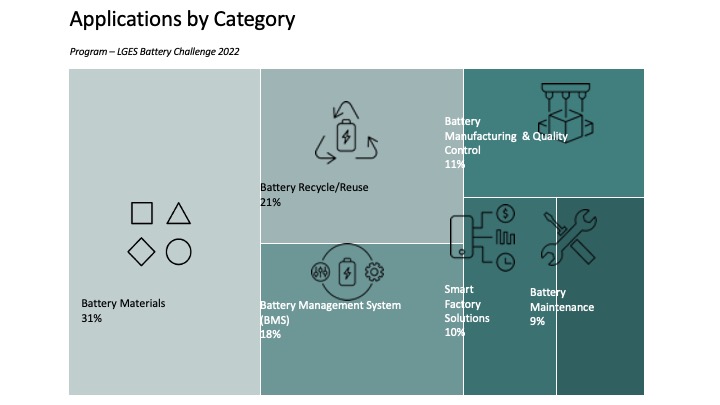
The LGES Battery Challenge is recruiting early-stage battery startups in areas of battery materials, battery management system, battery manufacturing and quality control, battery maintenance, battery recycling and reuse technology, and newly added smart factory solutions. The program’s selection criteria will favor applicants with competitive solutions, experienced teams, customer traction and an execution ready POC proposal.

“LG Energy Solution’s has continued to pave the way for battery innovation. We are excited to be working with LGES again to help realize their ambition and most importantly supporting startups along the way,” says Andrew Chang, Program Director, New Energy Nexus.

The LGES Battery Challenge application window is from August 8 to September 16. New Energy Nexus is the manager and facilitator for this challenge.

www.lgesbatterychallenge2022.com

LG Energy Solution

LG Energy Solution is a global leader delivering advanced lithium-ion batteries for Electric Vehicles (EV), Mobility & IT applications, and Energy Storage Systems (ESS). With 30 years of experience in advanced battery technology, it continues to grow rapidly towards the realization of sustainable life. With its robust global network that spans the US, Europe, Asia, and Australia, LG Energy Solution is more committed than ever to developing innovative technologies that will bring the future energy a step closer. Under its ESG vision “We CHARGE toward a better future,” LG Energy Solution is doing its utmost to prioritize the environment, fulfill social responsibilities and shape a sustainable future.

For more information, please visit https://www.lgensol.com.

Media contacts:

Jenny Kao
Program Manager
jenny.kao@newenergynexus.com

Tristan Tremschnig
Communications Director, New Energy Nexus (based in San Francisco, USA)
tristan.tremschnig@newenergynexus.com 

About New Energy Nexus

New Energy Nexus (NEX) is an international organization that strives towards a 100% clean energy economy for 100% of the population. It does this with a laser focus on diverse entrepreneurs, supporting them with accelerators, funds, skills, and networks they need to thrive. NEX has accelerated 1,500+ startups, empowered over 10,400+ entrepreneurs, and mobilized over US$4.7 billion in investment. Since its founding in California in 2004, NEX now operates programs or advisory services in Australia, China, India, Indonesia, Nigeria, Pakistan, the Philippines, Thailand, the UAE, Uganda, the USA (California and New York), and Vietnam.

Follow NEX on LinkedIn, X, Facebook, and YouTube

About New Energy Nexus

New Energy Nexus (NEX) is an international organization that strives towards a 100% clean energy economy for 100% of the population. It does this with a laser focus on diverse entrepreneurs, supporting them with accelerators, funds, skills, and networks they need to thrive. NEX has accelerated 1,400 startups, empowered over 9,500 entrepreneurs, and mobilized over US$3.7 billion in investment. Since its founding in California in 2004, NEX now operates programs or advisory services in Australia, China, India, Indonesia, Nigeria, Pakistan, the Philippines, Thailand, the UAE, Uganda, the USA (California and New York), and Vietnam.

Follow NEX on LinkedIn, X, Facebook, and YouTube

Story
Uganda
Energy Access
Uganda’s rural entrepreneurs are a model for clean energy access in Africa

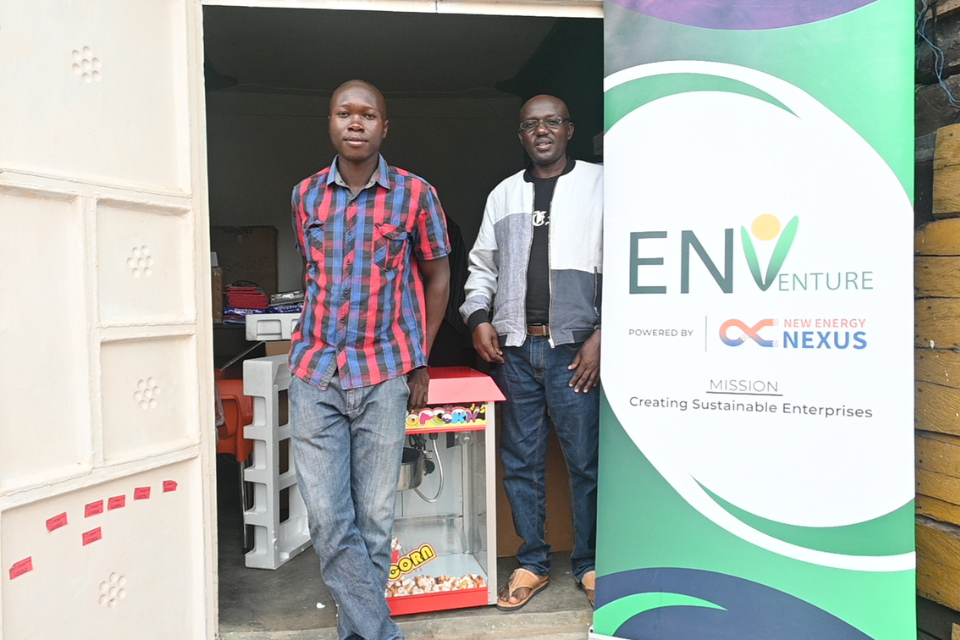
It’s a little known fact outside of this part of the world, that Uganda is a hotspot for entrepreneurs. My home of Uganda is brimming with an enterprising community ranked as one of the most entrepreneurial in the world. So as someone working in the climate space for 7 years, I didnt just see the climate talks in Glasgow as an opportunity to tackle climate change, but also as an opportunity for entrepreneurs to help Uganda leapfrog dirty fossil fuels and serve communities across the country with clean energy. 

This is particularly urgent for remote and marginalised communities that risk being left behind in the global clean energy transition. In Uganda, only 19% of the country’s rural communities have access to electricity, and less than 2% have access to modern cooking facilities. But rather than rely on highly centralised dirty fossil fuels, there’s an opportunity to transition directly to clean energy.

The nonprofit I work for, New Energy Nexus, helps create new markets for clean energy products in these remote areas – a model that won the Ashden Award for clean energy access at COP26.  There are several lessons we’ve learned in the last 5 years that can help scale the clean energy transition.

Firstly, access to funding in rural entrepreneurs is crucial to unlocking innovation.

Uganda’s startup scene is booming, but all too often, the benefits of clean energy don’t make it beyond the nation’s major cities or towns and the reason is often lack of access to stable funding.

For instance, if you look at the local economies in rural communities, most villages are dependent on agriculture and are exposed to its climate change-induced seasonal challenges. So if you run a shop and sell products there, you will have on average about six months of very good income and six months of very low income. And yet there are fixed costs over the whole period: you have to pay the rent and your employees. This is how easier access to funding can help an entrepreneur such as a farmer who may need to access a solar water pump for production during dry spells and rent it out to another farmer for a fee.

However, funding for such initiatives is not easily available for rural farmers or individuals because of the conditions that come with acquiring the fund with the most common one being high interest rates and collateral. 

Secondly, increasing uptake of clean energy products depends on a bottom-up approach.

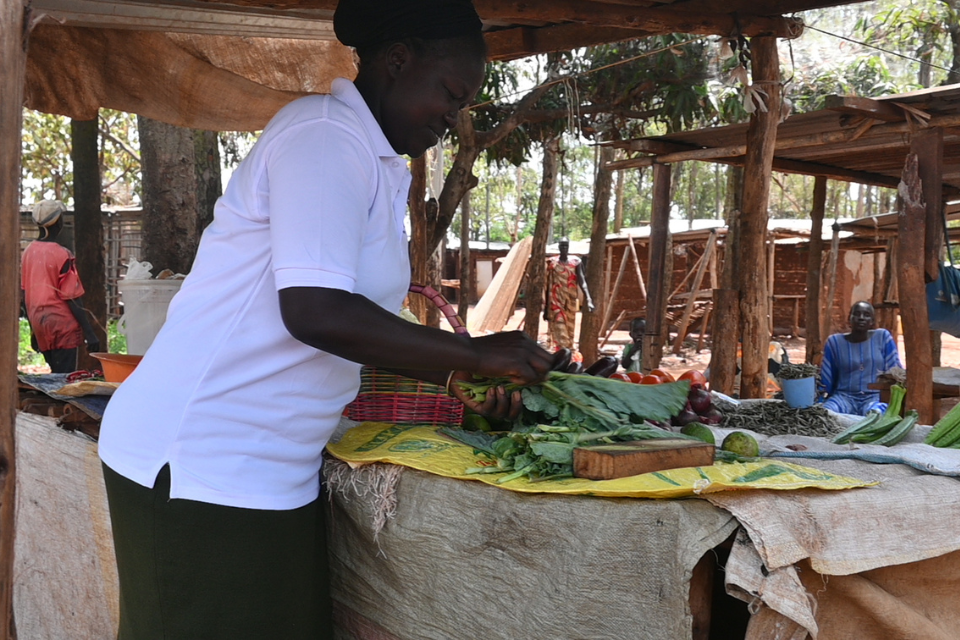
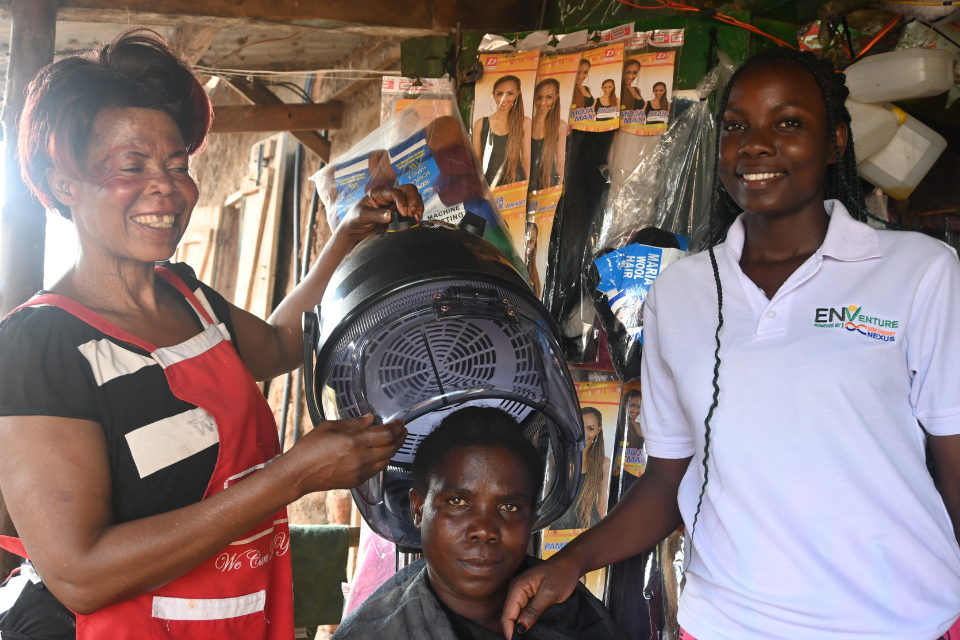
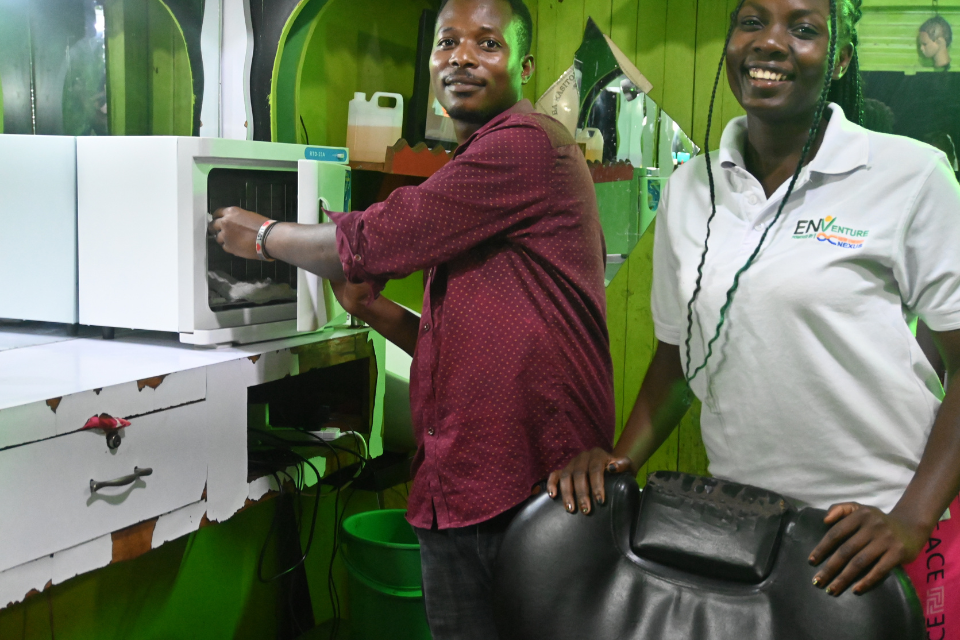
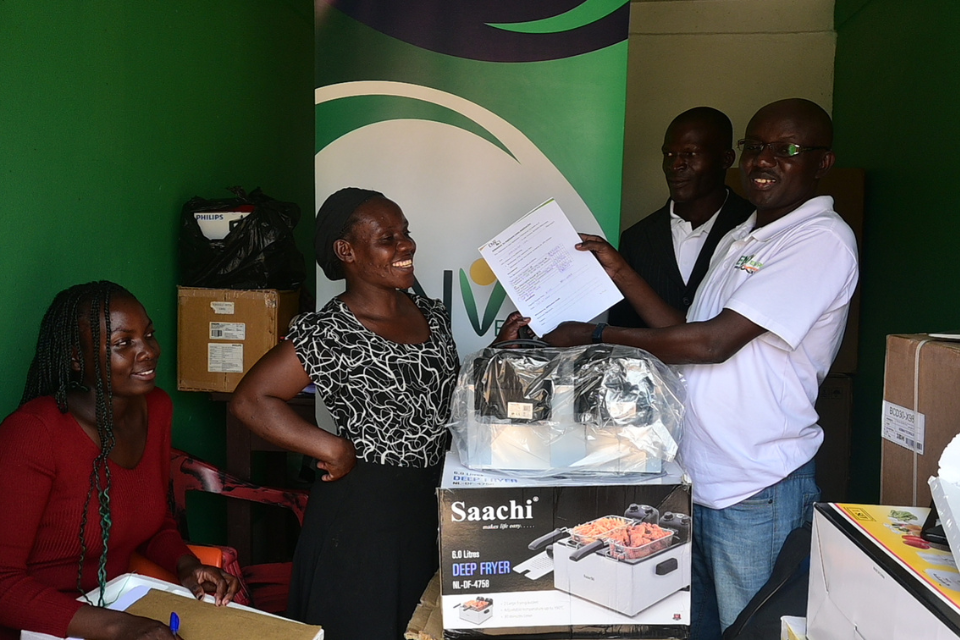
In rural Uganda, community-based organisations (CBOs) provide many essential services – supporting better health, education, sanitation and work for local people. We learned very quickly that these organisations have the networks, trust, and community reputation to bring new technologies, such as solar lights, water filters, briquettes and clean energy cookstoves, to rural villages.  

Their vital social role can be leveraged to increase uptake of renewable energy through retail and advocacy. It is these CBOs that understand the buying patterns of their customers by providing credit payment facilities like installments payment, which are most favorable for customers. It is not just CBOs that can drive this change forward. 

Uganda, like much of Subsaharan Africa, is home to tens of thousands of village-level nonprofit groups like Farming Groups and SACCOs that are typically self organised and self managed to address gaps in service delivery. Working with such networks is one way an ecosystem can be built and grown from the ground up.

Finally, skills training is as important as technology and hardware.

Providing loans and hardware is only one part of the solution. Developing skills to run a business and maintain the products are an essential – though far less glamorous aspect – of the clean energy transition.

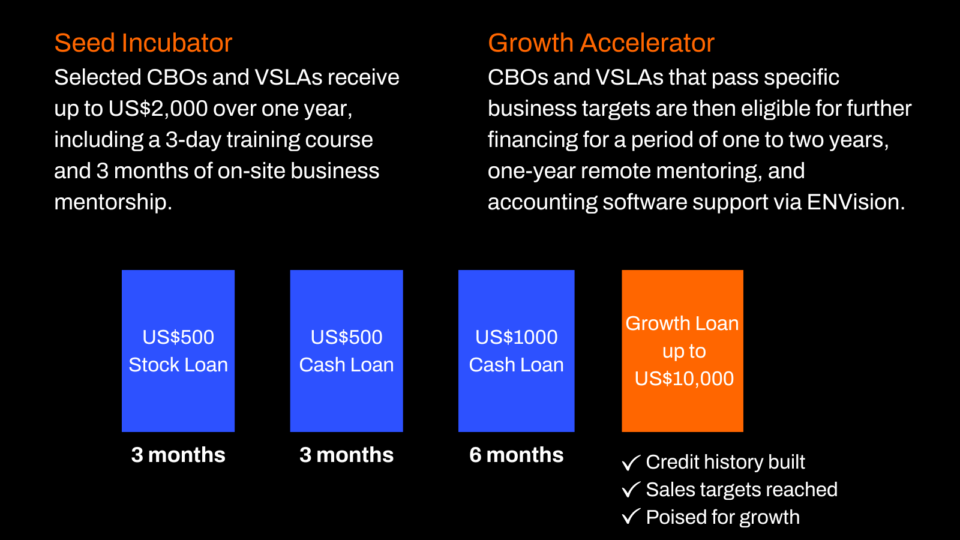
For example, we provided RFCare in the Rwenzori Highlands a US$2,000 loan to support the sale of cookstoves that create less air pollution than traditional models, as well as fuel briquettes and water filters. The loan also helped train young people in cookstove manufacture and repair and so far, the CBO has sold 1,800 stoves.

Entities like RFCare are staffed by passionate young people who are now exposed, more than ever, to the increasing innovation we see around today. If they are equipped with the technical or business expertise of running a clean energy enterprise, they are able to serve growing populations with solutions that fulfill our energy demands. 

Tackling climate change in Uganda provides essential lessons on how the continent can scale climate action, while also increasing access to clean energy products. Entrepreneurs are weighting in the wings – they just need the funding and the skills.  Local governments and funders must throw their weight behind supporting and scaling small and medium-sized clean energy businesses before it’s too late.

Marvin Tumusiime is the New Energy Nexus Uganda, Abundance Team Manager. This article was first published in Business Daily Africa as an op-ed.

Explore More