Story
Indonesia
Transportation tech
Indonesia is solving the wrong half of its fuel problem
Explore More
Story
Indonesia
Renewable energy tech
Transportation tech
Could rising gas prices supercharge Indonesia’s shift to clean energy?

Written by Jennifer Wang, Director of Financial Innovation at New Energy Nexus
1

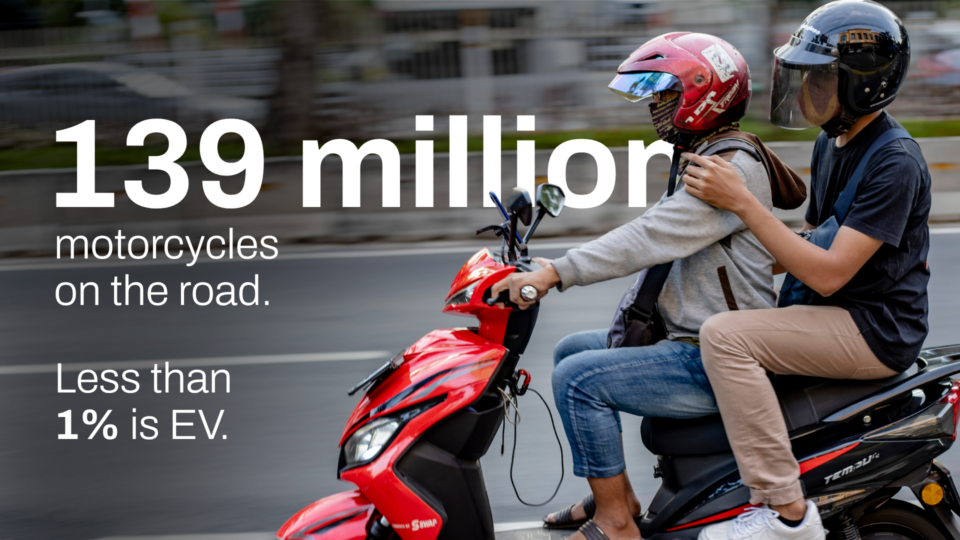
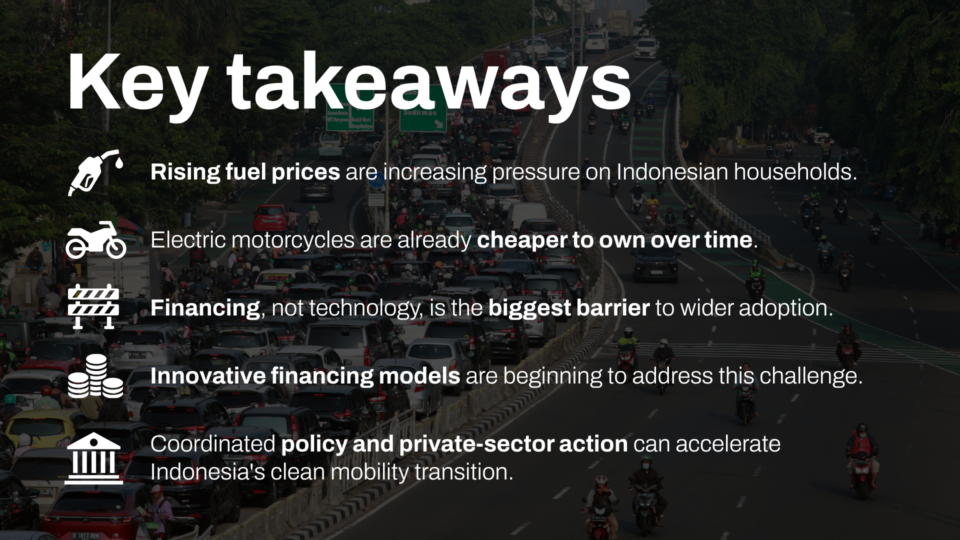
Anyone who lives in or has visited Jakarta will have seen the motorcycles: slipping between cars, gathering at intersections, carrying passengers, food orders, parcels, tools, and stock for small businesses. They are often treated as part of the traffic problem, but in Indonesia they are the backbone of the transportation system. With around 139 million two-wheel vehicles on the road, Indonesia’s motorcycle market is the third largest in the world, but less than 1% of those are electric.

This is why the energy crisis is hitting Indonesians hard.

State-owned energy company Pertamina raised the price of its flagship Pertamax gasoline by more than 30 percent in June, from Rp12,300 to Rp16,250 a litre. This is causing consumers to take a hit to their personal income, or else switch to the lower grade government-subsidized Pertalite fuel, which some fear could cause long-term damage to their vehicles. Long queues have already been observed at many gas stations across the country, and there is no telling how long the government will be able to continue to shoulder the growing cost of subsidizing Pertalite, despite assurances from the energy minister.

The solution seems obvious: reduce the nation’s dependence on fossil fuels.

In fact, Indonesian President Prabowo Subianto has framed reducing dependence on imported fossil fuels as a strategic national priority and the country already has ambitious targets for EVs. But accelerating EV adoption, especially two-wheelers, will require a multipronged approach that includes policy and financial solutions.

For drivers, couriers, and low-to-middle income households, multiple barriers are holding back the switch to electric motorcycles. Government incentives have been inconsistent, with the 2023 purchase subsidy introduced and then withdrawn less than two years later. And consumers remain hesitant, wary of a technology that hasn’t yet earned their trust or proven its resale value.

Beyond that, the EV landscape is fragmented, dominated by over 65 young local brands rather than the household names like Honda and Yamaha that anchor the internal combustion engine (ICE) market. Upfront costs are higher than traditional ICE vehicles, with little affordable financing to bridge the gap, and the charging, swapping, and repair infrastructure that ICE riders take for granted is nascent and uneven for EVs — growing, but nowhere near the density or reliability riders need.

Adoption is lagging
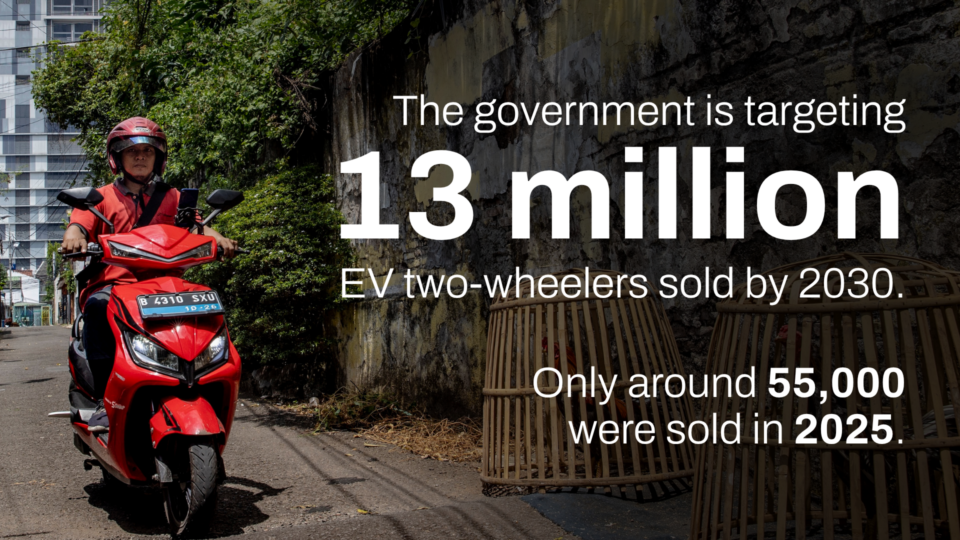
Electric motorcycles are already cheaper to operate: according to think tank RMI, the total cost of ownership of an electric motorcycle is at least 34% lower than an equivalent ICE vehicle, freeing up income for food, school, utilities, and other household needs.

Yet adoption remains far below its potential, with electric motorcycles accounting for fewer than 230,000 units, or less than 1% of the total fleet. Annual electric motorcycle sales reached only around 55,000 units in 2025, less than 1% of new motorcycle sales.

The gap between ambition and reality is also striking. The previous administration set a target of 13 million electric motorcycles on Indonesian roads by 2030, but even optimistic industry projections put annual electric motorcycle sales at around 1.9 million by 2030.

Electric motorcycles, despite representing arguably the strongest energy security opportunity, have received comparatively less policy attention. Responsibility for the EV transition is split across the energy, industry, finance, and transport ministries, and coordination among them has remained weak, with no single institution effectively driving it. Indeed, much of Indonesia’s recent EV momentum has centered upstream, on nickel mining and processing – of which Indonesia is the producer for the world – and battery materials.

Financial barriers to adoption

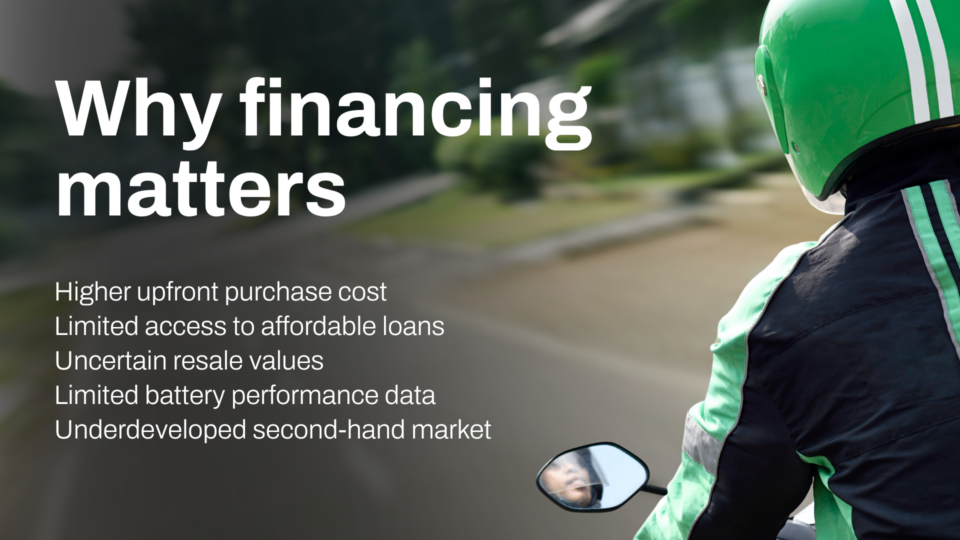
Policy, however, only gets us so far. The biggest barrier for consumers is the high upfront cost. Electric motorcycles remain approximately Rp5-6 million (US$280 to US$336) more expensive than comparable conventional motorcycles and financing is one of the most significant obstacles to wider adoption.

While around 80-90% of conventional motorcycle purchases in Indonesia are financed according to our own stakeholder interviews, only a small fraction of electric motorcycle buyers currently access the formal lending market. Where loans are available, the terms are often less favorable than those offered for conventional motorcycles.

Furthermore, as households come under financial pressure, consumers often delay major purchases, including vehicles. This creates an important challenge for the EV transition. Even if electric vehicles offer lower operating costs over the long term, their upfront cost can remain out of reach for many households, particularly when there is not a robust secondary market that could give consumers comfort that they can quickly sell their vehicle for cash if financial pressures mount. This reality highlights why affordability matters just as much as technology.

These conditions reflect legitimate concerns among lenders, too. Electric motorcycles are still a relatively new asset class, with limited data on battery performance, resale value, and long-term reliability.

The same concern that consumers have about being able to liquidate their vehicles in a pinch also affects lenders and the residual value they would receive for the vehicle if it had to be repossessed. The fragmented EV landscape and less developed after-sales market also increase the risk that a borrower would be unable to make payments on the loan if a faulty vehicle prevents the driver from utilizing it for their livelihood. The result is that financing often becomes inaccessible for the very consumers who stand to benefit most from lower operating costs, particularly ride-hailing drivers, delivery workers, and low-to-middle income households.
The solutions that need scaling

Several Indonesian companies are experimenting with financing models designed specifically for the realities of the country’s motorcycle market.

One example is Indonesian EV startup’s Cocoride platform, which combines battery-swapping infrastructure with rent-to-own financing and provides drivers with access to electric motorcycles without many of the barriers associated with conventional vehicle loans. Through daily repayment structures, remote monitoring technology, and rapid vehicle redeployment, the model is designed around the realities of Indonesia’s informal and platform-based workforce. Along with Cocoride, there are a handful of other innovative financing structures being deployed (Electrum, Aizen, and Blitz Electric Mobility are just a few) that help these livelihood drivers access the significant benefits of driving and owning an electric motorcycle.

What these innovations have in common is an understanding that the challenge is not simply selling electric motorcycles. It is designing financial products and support systems that match how Indonesians actually earn, spend, and use transportation assets.

This is also where new policy and financing solutions can play an important role. Across emerging markets, governments, financiers, and development institutions are increasingly exploring tools such as guarantee facilities, blended finance structures, and risk-sharing mechanisms that can reduce lender exposure and unlock private capital for electric mobility. Policy interventions are being designed to support this mobilization, as well as to align with countries’ domestic manufacturing and industrial policy goals.

The opportunity

The clean energy transition that protects Indonesia from the next geopolitical oil shock also builds a domestic industry, creates jobs in manufacturing and battery production, and lowers the cost of mobility for the millions of Indonesians whose livelihoods depend on two wheels.

To accelerate adoption, Indonesia will need coordinated solutions that reduce the initial financial burden on consumers and help get more electric motorcycles on the road to create a secondary market. New Energy Nexus and UC Davis’ Global South Center for Clean Transportation are exploring possible policy and financing solutions, such as fiscal and non-fiscal policy, blended finance schemes, consumer and lender education, and mobility-as-a-service schemes.

This moment of crisis creates an opening to supercharge a mass transition to EVs.

Not only will a transition to electric two-wheelers support Indonesia’s emissions reduction targets, it will also offer  financial stability for the millions of Indonesians who rely on their motorcycles to support their livelihoods.
Explore More
News
Indonesia
Transportation tech
Increasing fuels costs show why Indonesia must move faster on clean transport
Media contacts:

About New Energy Nexus

New Energy Nexus (NEX) is the world’s leading clean energy ecosystem builder, working toward a 100% clean energy economy for 100% of the population. It does this with a laser focus on diverse entrepreneurs, supporting them with accelerators, funds, skills, and building the local and global connections they need to thrive. NEX has accelerated 1,700+ startups and businesses, empowered over 11,500+ entrepreneurs, and mobilized more than US$5.4 billion in investment.

Since its founding in California in 2004, NEX now operates programs or services in Australia, China, India, Japan, Indonesia, Nigeria, Pakistan, the Philippines, South Korea, Thailand, Uganda, the USA (California and New York), and Vietnam.

Follow NEX on LinkedIn, X, Facebook, and YouTube

News
Australia
Transportation tech
Mass EV retrofit startup Veepower wins second Supercharge Australia Innovation Challenge
15

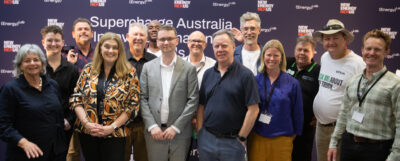
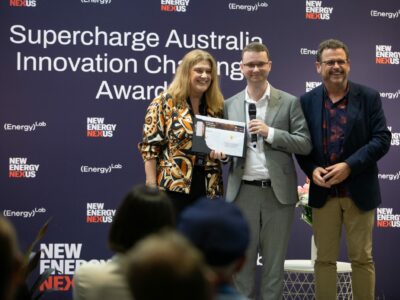
From left: EnergyLab CEO & Director Megan Fisher, Veepower Founder & lead software developer Kyle Van Berendonck, and New Energy Nexus Venture Partner & EnergyLab volunteer Danny Kennedy.

Sydney, Australia, 8 November 2024 – Plug-and-play EV software control system provider, Veepower has won the second Supercharge Australia Innovation Challenge with its unique technology that unlocks mass EV retrofits across thousands of potential installers and designers in Australia and overseas.

“We have a product that can enable anyone with a garage to repower any vehicle class into an EV with about the same effort as doing an engine swap – from individuals to company fleets. We’re incredibly excited to scale from what we’ve learned in the Supercharge Australia Innovation Challenge and unlock rapid growth in mass EV retrofits,” said Kyle Van Berendonck, founder and lead software developer of Melbourne-based Veepower, an offshoot of Cuedo Controls.

supercharge australia innovation challenge awards nov 2024 veepower veepilot product trans

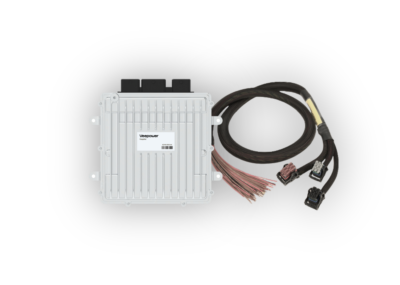
Veepower’s solution, the Veepilot.

The second annual Supercharge Australia Innovation Challenge winner was selected from a cohort of 12 startups with solutions to rapidly convert half the Australian vehicle fleet to electric vehicles (EVs), equivalent to more than 10 million vehicles.

“This cohort will be the spark for an industry that could electrify half the Australian vehicle fleet and increase domestic battery demand twenty times over to 1.3TWh, while providing the skills, services and equipment to emerging markets around the world,” said Kirk McDonald, Project Manager for Supercharge Australia. “In Australia alone we have the potential to generate demand for AU$181 billion worth of Australian-made lithium batteries, targeting a replacement market of AU$700 billion in vehicle sales.”

“A vehicle retrofit industry will create a jobs and skills pathway for mechanics, auto-electricians, and advanced manufacturing workers, while also accelerating the decarbonisation of our transport sector. It’s win-win, and we’re thrilled to support startups like Veepower to scale its impact,” said Megan Fisher, CEO of EnergyLab.

supercharge australia innovation challenge awards nov 2024 full cohort

The cohort of startups who joined the SuperCharge Australia Innovation Challenge: Retrofit Nation.

In 2022 the transport sector contributed to 19% of Australia’s emissions, with trucks, buses and light commercial vehicles accounting for about 40% of the total transport figure.  The Challenge aimed to find solutions that can deploy up to 1.3TWh of batteries that would be required to reach this goal, starting with approximately 600GWh of heavy truck and bus batteries (plus up to 25GWh for  mining), 400GWh for light trucks and commercial vehicles and 260GWh for passenger vehicles. By accelerating all forms of EV uptake, both additional CO2 emissions will be avoided and grid storage expenditure reduced.

Veepower will now have the opportunity to join an expert guided visit by Danny Kennedy, EnergyLab Director and Venture Partner at New Energy Nexus Ventures, to California’s startup ecosystem, centred in the San Francisco Bay Area.

Supercharge Australia is accelerating the lithium battery value chain in Australia, and is a joint project of not-for-profit cleantech startup support organisations New Energy Nexus globally and EnergyLab in Australia and New Zealand.


The twelve startups in the second Supercharge Innovation Challenge were:

  • Australian EVS, Newcastle, NSW: light commercial EV retrofits for councils and fleets.
  • Veepower, an offshoot of Cuedo Controls, Melbourne, VIC: efficient EV software control systems for the entire retrofit market.
  • Eclass Outboards, Kiama, NSW: electric outboard and marine hybrid retrofits for pleasure craft and fishing fleets.
  • Electric Power Conversions Australia (EPCA), Hazelmere, WA: EV retrofitting mining haul trucks from 100 tonnes and up
  • Electromotiv, Canberra, ACT: EV retrofitting buses for public transport and private fleets
  • Evans Electric, Sydney, NSW: EV powertrain hardware and software developer specialising in axial flux motor development including e-axles
  • IonDNA, ACT and NSW: power electric ATVs, utility vehicles, and farm tools from electricity generated via on-site solar power infrastructure.
  • Jaunt, Melbourne, VIC: EV conversion systems for classic cars and specialist commercial vehicles.
  • Net Zero Engineering Solutions, Adelaide, SA: bi-directional EV charging solution.
  • OZ Electric Vehicles, Logan City, QLD: battery upscaling and “flat pack” EV retrofit kits.
  • “Project Midas,” Sydney, NSW: next-generation graphene anode technology, improving lithium-ion battery performance and safety.
  • REVR, Melbourne, VIC: Minimised installation requirement mass EV retrofit kits.

Media contacts:

Kirk McDonald
Project Manager, Supercharge Australia
kirk.mcdonald@newenergynexus.com
+61 412 336 848

Tristan Tremschnig
Global Communications Director, New Energy Nexus
tristan.tremschnig@newenergynexus.com
(based in San Francisco)

About New Energy Nexus

New Energy Nexus (NEX) is the world’s leading clean energy ecosystem builder, working toward a 100% clean energy economy for 100% of the population. It does this with a laser focus on diverse entrepreneurs, supporting them with accelerators, funds, skills, and building the local and global connections they need to thrive. NEX has accelerated 1,700+ startups and businesses, empowered over 11,500+ entrepreneurs, and mobilized more than US$5.4 billion in investment.

Since its founding in California in 2004, NEX now operates programs or services in Australia, China, India, Japan, Indonesia, Nigeria, Pakistan, the Philippines, South Korea, Thailand, Uganda, the USA (California and New York), and Vietnam.

Follow NEX on LinkedIn, X, Facebook, and YouTube

About New Energy Nexus

New Energy Nexus (NEX) is an international organization that strives towards a 100% clean energy economy for 100% of the population. It does this with a laser focus on diverse entrepreneurs, supporting them with accelerators, funds, skills, and networks they need to thrive. NEX has accelerated 1,400 startups, empowered over 9,500 entrepreneurs, and mobilized over US$3.7 billion in investment. Since its founding in California in 2004, NEX now operates programs or advisory services in Australia, China, India, Indonesia, Nigeria, Pakistan, the Philippines, Thailand, the UAE, Uganda, the USA (California and New York), and Vietnam.

Follow NEX on LinkedInXFacebook, and YouTube

About EnergyLab

EnergyLab is Australia’s largest climate tech startup accelerator and innovation network dedicated to reaching net zero emissions. EnergyLab connects talented founders to the mentors, advisors, partners, peers and investors they need to succeed and has so far supported over 200 startups and 140 aspiring founders through its various programs.

In addition to running 10 programs, EnergyLab operates a climate focused angel investor network with over 200 angel investors, a mentor network with over 400 experts, coworking and events space at UTS in Sydney all of these services are leveraged to support the clean energy and decarbonisation startup ecosystem in Australia.

News
Australia
Transportation tech
12 startups announced in new Supercharge Australia Innovation Challenge to EV retrofit nation’s vehicle fleet

Sydney, 18 September 2024 – The second annual Supercharge Australia Innovation Challenge announces today a new cohort of 12 startups with solutions to rapidly convert half the Australian vehicle fleet to electric vehicles (EVs), equivalent to more than 10 million vehicles.

The Challenge aims to find solutions that can deploy up to 1.3TWh of batteries that would be required to reach this goal, starting with approximately 600GWh of heavy truck and bus batteries (plus up to 25GWh for  mining), 400GWh for light trucks and commercial vehicles and 260GWh for passenger vehicles [1].

The startups selected for the cohort are:

  • Australian EVS, Newcastle, NSW: light commercial EV retrofits for councils and fleets.
  • Cuedo Controls, Melbourne, VIC: efficient EV software control systems for the entire retrofit market.
  • Eclass Outboards, Kiama, NSW: electric outboard and marine hybrid retrofits for pleasure craft and fishing fleets.
  • Electric Power Conversions Australia (EPCA), Hazelmere, WA: EV retrofitting mining haul trucks from 100 tonnes and up
  • Electromotiv, Canberra, ACT: EV retrofitting buses for public transport and private fleets
  • Evans Electric, Sydney, NSW: EV powertrain hardware and software developer specialising in axial flux motor development including e-axles
  • IonDNA, ACT and NSW: power electric ATVs, utility vehicles, and farm tools from electricity generated via on-site solar power infrastructure.
  • Jaunt, Melbourne, VIC: EV conversion systems for classic cars and specialist commercial vehicles.
  • Net Zero Engineering Solutions, Adelaide, SA: bi-directional EV charging solution.
  • OZ Electric Vehicles, Logan City, QLD: battery upscaling and “flat pack” EV retrofit kits.
  • “Project Midas, Sydney, NSW: next-generation graphene anode technology, improving lithium-ion battery performance and safety.
  • REVR, Melbourne, VIC: Minimised installation requirement mass EV retrofit kits.

“This is the first innovation challenge of its type in Australia to focus on mass EV retrofitting vehicles. With the incredible increase in battery demand this would generate, we aim to change the conversation on the viability of battery and cell manufacturing in Australia, taking advantage of our huge competitive advantage in the lithium battery supply chain,” said Kirk McDonald, Project Manager for Supercharge Australia.

“Not only would retrofitting half the Australian vehicle fleet to electric vehicles rapidly reduce emissions from transport, it would also support a big capacity uplift in our startup innovation ecosystem and clean energy advanced manufacturing,” said Megan Fisher, CEO of EnergyLab.

Participants in the inaugural Supercharge Australia Innovation Challenge in 2023 raised over AU$48 million in funding subsequent to the first Challenge. Applicants this year will benefit from technical support, networking, mentoring, wide exposure and introductions to investors and customers in an industry roundtable to accelerate their success.

Delivered over two months with most sessions online, startups will receive advice from international and domestic experts in finance, IP and business growth, and pitching the opportunity to investors. This will culminate in the second Supercharge Australia Innovation Challenge Awards event, in Sydney on November 7.

The winning startup will also have the opportunity to join an expert guided visit by Danny Kennedy, EnergyLab Director and Venture Partner at New Energy Nexus Ventures, to California’s startup ecosystem, centred in the San Francisco Bay Area.

“It’s a perfect time to showcase the world-beating ambition and technical know-how this team has to decarbonise half Australia’s vehicle fleet, all with Australian-made lithium batteries,” said Danny Kennedy.

The Challenge aims to rapidly decarbonise the transport sector and accelerate battery demand.  In 2022 the transport sector contributed to 19% of Australia’s emissions, with trucks, buses and light commercial vehicles accounting for about 40% of the total transport figure. The potential CO2 savings are critically important; and vehicle acquisition cost savings of up to 50% per vehicle in comparison to new purchases have been identified in overseas markets.

Supercharge Australia is accelerating the lithium battery value chain in Australia, and is a joint project of not-for-profit cleantech startup support organisations New Energy Nexus globally and EnergyLab in Australia and New Zealand.

Notes:

Photos are available here.

[1] Calculations apply expert-advised current and at-scale estimates of lithium battery, electric motor, software control systems, wages and ancillary design and other costs to the Australian vehicle fleet data from Bureau of Infrastructure and Transport Research Economics. “Motor Vehicles, Australia, January 2022 (First Issue).”


About New Energy Nexus

New Energy Nexus (NEX) is an international organization that strives towards a 100% clean energy economy for 100% of the population. It does this with a laser focus on diverse entrepreneurs, supporting them with accelerators, funds, skills, and networks they need to thrive.

NEX has accelerated over 1,200 startups, supported nearly 9,000 entrepreneurs, and mobilized over US$3.7 billion in investment. Celebrating 20 years since its founding in California in 2004, NEX now operates programs or advisory services in Australia, China, India, Indonesia, Nigeria, Pakistan, the Philippines, Thailand, the UAE, Uganda, the USA (California and New York), and Vietnam. More at www.newenergynexus.com

About EnergyLab

EnergyLab is Australia’s largest climate tech startup accelerator and innovation network dedicated to reaching net zero emissions. EnergyLab connects talented founders to the mentors, advisors, partners, peers and investors they need to succeed and has so far supported over 195 startups and 140 aspiring founders through its various programs.

In addition to running 10 programs, EnergyLab operates a climate focused angel investor network with over 200 angel investors, a mentor network with over 400 experts, coworking and events space at UTS in Sydney all of these services are leveraged to support the clean energy and decarbonisation startup ecosystem in Australia.

Media contacts:

Kirk McDonald
Project Manager, Supercharge Australia
kirk.mcdonald@newenergynexus.com
+61 412 336 848

Tristan Tremschnig
Global Communications Director, New Energy Nexus
tristan.tremschnig@newenergynexus.com
(based in San Francisco)

About New Energy Nexus

New Energy Nexus (NEX) is the world’s leading clean energy ecosystem builder, working toward a 100% clean energy economy for 100% of the population. It does this with a laser focus on diverse entrepreneurs, supporting them with accelerators, funds, skills, and building the local and global connections they need to thrive. NEX has accelerated 1,700+ startups and businesses, empowered over 11,500+ entrepreneurs, and mobilized more than US$5.4 billion in investment.

Since its founding in California in 2004, NEX now operates programs or services in Australia, China, India, Japan, Indonesia, Nigeria, Pakistan, the Philippines, South Korea, Thailand, Uganda, the USA (California and New York), and Vietnam.

Follow NEX on LinkedIn, X, Facebook, and YouTube

Story
Australia
Transportation tech
Turning half of Australia’s vehicle fleet into EVs? Challenge accepted.
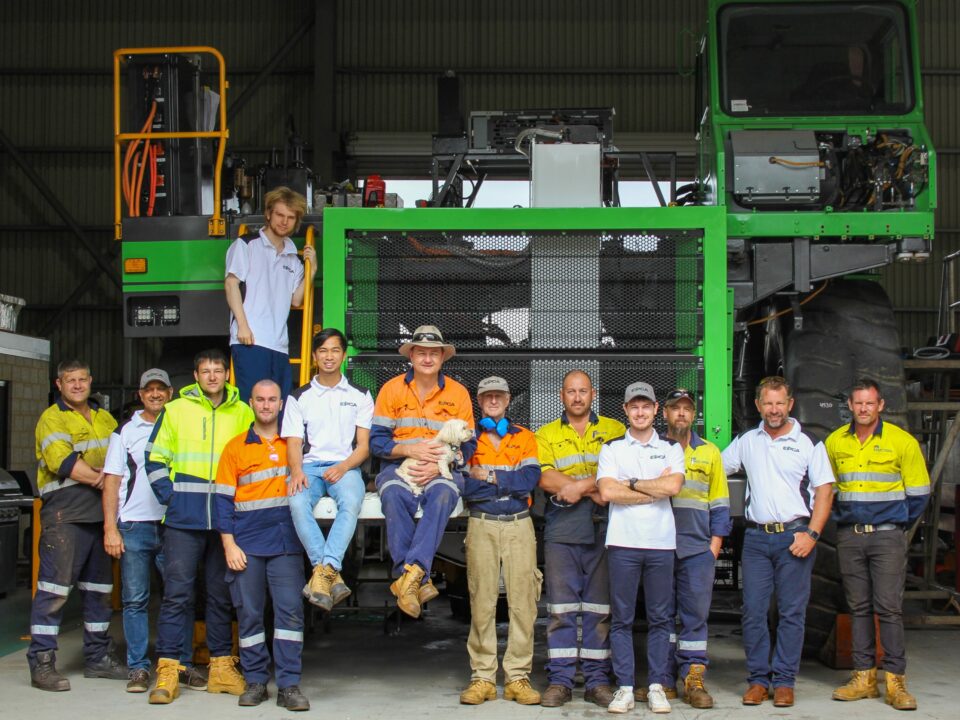
Clayton Franklin with the team at Electric Power Conversions Australia and their electrified Cat 777 100-tonne haul truck.

Clayton Franklin with the team at Electric Power Conversions Australia and their electrified Cat 777 100-tonne haul truck.

Supercharge Australia welcomes 12 startups who have accepted our second annual Innovation Challenge—Retrofit Nation!

Beginning in August, we sought startups with solutions to convert half of Australia’s vehicle fleet into electric vehicles (EVs), or 10 million vehicles. To achieve this, they will need to find ways to deploy up to 1.3TWh of batteries that would be required to reach this goal.

Applicants this year will benefit from technical support, networking, mentoring, wide exposure, and introductions to investors and customers in an industry roundtable to accelerate their success.

Delivered over two months with most sessions online, startups will receive advice from international and domestic experts in finance, IP, and business growth, and pitching the opportunity to investors. This will culminate in the second Supercharge Australia Innovation Challenge Awards event, in Sydney on November 7. Participants in the inaugural Supercharge Australia Innovation Challenge in 2023 raised over AU$48 million in funding after the first Challenge.

saic2 zoom photo

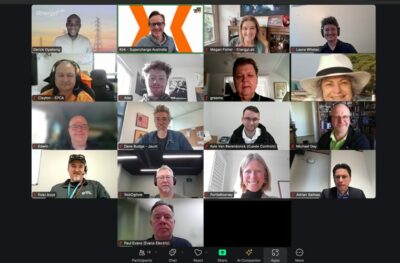
Participating startups join a virtual call with the team behind Supercharge Australia Innovation Challenger 2: Retrofit Nation.

“This is the first innovation challenge of its type in Australia to focus on mass EV retrofitting vehicles. With the incredible increase in battery demand this would generate, we aim to change the conversation on the viability of battery and cell manufacturing in Australia, taking advantage of our huge competitive advantage in the lithium battery supply chain,” said Kirk McDonald, Project Manager for Supercharge Australia.

“Not only would retrofitting half the Australian vehicle fleet to electric vehicles rapidly reduce emissions from transport, it would also support a big capacity uplift in our startup innovation ecosystem and clean energy advanced manufacturing,” said Megan Fisher, CEO of EnergyLab.

The Challenge aims to rapidly decarbonise Australia’s transport sector, which in 2022 contributed to 19% of Australia’s emissions; with trucks, buses, and light commercial vehicles accounting for about 40% of the total transport figure. The potential CO2 savings are critically important, and vehicle acquisition cost savings of up to 50% per vehicle in comparison to new purchases have been identified in overseas markets.

Get to know each participating startup’s business model and hear from their founders below (click dropdowns for full descriptions):

australia evs

Australian EVS

Newcastle, NSW

Their business: Light commercial EV retrofits for councils and fleets.

Why they’re joining the challenge: “To meet like-minded businesses who are focused on transitioning Australia to zero emission transport.” — Edwin Higginson, Founder

cuedo controls

Cuedo Controls

Melbourne, VIC

Their business: Efficient EV software control systems for the entire retrofit market.

Why they’re joining the challenge: “To see the best EV retrofit practitioners Australia has to offer.” — Kyle Van Berendonck, Founder

eclass outboards

Eclass Outboards

Kiama, NSW

Their business: Electric outboard and marine hybrid retrofits for pleasure craft and fishing fleets.

Why they’re joining the challenge: “Connecting with battery suppliers, connecting with the retrofit community. Becoming investment ready.” — Lynelle Johnson, Founder

electric power conversions australia

Electric Power Conversions Australia

Hazelmere, WA

Their business: EV retrofitting mining haul trucks from 100 tonnes and up

Why they’re joining the challenge: “Because it aligns perfectly with our mission to drive sustainable transformation in the mining industry… We’re looking forward to connecting with like-minded innovators, demonstrating the viability of our technology, and pushing the boundaries of what’s possible to create a greener, more efficient mining future for Australia and beyond.” — Clayton Franklin, Founder

electromotiv landscape

Electromotiv

Canberra, ACT

Their business: EV retrofitting buses for public transport and private fleets.

Why they’re joining the challenge: “This could be the beginning of an incredible decarbonisation journey!” — Adrian Salinas, Founder

evans electric

Evans Electric

Sydney, NSW

Their business: EV powertrain hardware and software developer specialising in axial flux motor development including e-axles

Why they’re joining the challenge: “Excited by the opportunity to scale next-generation EV powertrains in Australia.” — Paul Evans, Founder

iondna

IonDNA

ACT and NSW

Their business: Power electric ATVs, utility vehicles, and farm tools from electricity generated via on-site solar power infrastructure.

Why they’re joining the challenge: “Retrofit Nation aims to build the Australian lithium battery value chain. To succeed, demand for lithium batteries must massively increase, supported by a domestic market that consumes battery electric technology at scale. Rural Australia represents a significant market for this technology (and a significant challenge).” — Michael Day, Founder

jaunt

Jaunt

Melbourne, VIC

Their business: EV conversion systems for classic cars and specialist commercial vehicles.

Why they’re joining the challenge: “Australia has the design and engineering talent, the resources, and the culture to lead the world in electric vehicle conversions. Let’s make that happen.” — Dave Budge, Founder

net zero engineering solutions

Net Zero Engineering Solutions

Adelaide, SA

Their business: Bi-directional EV charging solution.

Why they’re joining the challenge: “The chance to help supercharge V2X in Australia and the broader transition to EVs.” — Portia Rooney, Founder

oz electric vehicles

OZ Electric Vehicles

Logan City, QLD

Their business: Battery upscaling and “flat pack” EV retrofit kits.

Why they’re joining the challenge: “We can see what’s needed (to decarbonise Australia’s vehicle fleet) and want to make it happen.” — Graeme Manietta, Founder

project midas

Project Midas

Sydney, NSW

Their business: Next-generation graphene anode technology, improving lithium-ion battery performance and safety.

Why they’re joining the challenge: “Excited about the opportunity to contribute further to the fast-growing and exceptional Australian ecosystem of startups around lithium battery technology!” — Laura Whelan, Founder

revr

REVR

Melbourne, VIC

Their business: Minimised installation requirement mass EV retrofit kits

Why they’re joining the challenge: “It will be exciting to pitch REVR to a new audience and to interact with other entrepreneurs and innovators!”Craig and Alexander Burton

Supercharge Australia is accelerating the lithium battery value chain in Australia, and is a joint project of not-for-profit cleantech startup support organisations New Energy Nexus globally and EnergyLab in Australia and New Zealand.


About New Energy Nexus

New Energy Nexus (NEX) is an international organization that strives towards a 100% clean energy economy for 100% of the population. It does this with a laser focus on diverse entrepreneurs, supporting them with accelerators, funds, skills, and networks they need to thrive.

NEX has accelerated over 1,200 startups, supported nearly 9,000 entrepreneurs, and mobilized over US$3.7 billion in investment. Celebrating 20 years since its founding in California in 2004, NEX now operates programs or advisory services in Australia, China, India, Indonesia, Nigeria, Pakistan, the Philippines, Thailand, the UAE, Uganda, the USA (California and New York), and Vietnam. More at www.newenergynexus.com

About EnergyLab

EnergyLab is Australia’s largest climate tech startup accelerator and innovation network dedicated to reaching net zero emissions. EnergyLab connects talented founders to the mentors, advisors, partners, peers and investors they need to succeed and has so far supported over 195 startups and 140 aspiring founders through its various programs.

In addition to running 10 programs, EnergyLab operates a climate focused angel investor network with over 200 angel investors, a mentor network with over 400 experts, coworking and events space at UTS in Sydney all of these services are leveraged to support the clean energy and decarbonisation startup ecosystem in Australia.

Explore More
News
Transportation tech
New Energy Nexus to support LG Energy Solution’s Battery Challenge program for next-generation battery tech startups

June 4, 2024 – New Energy Nexus is supporting LG Energy Solution’s launch of its fourth Battery Challenge, a global startup competition to discover and support innovative early-stage startups to develop next-generation battery technologies.

The Battery Challenge is LG Energy Solution’s mainstay open innovation initiative. While helping the growth of the distinguished companies, LG Energy Solution also aims to pioneer next-generation technologies through partnerships.

As the manager and facilitator of this program, New Energy Nexus is supporting overall operation.

This year’s Battery Challenge is recruiting early-stage battery startups in: battery materials, battery management system, battery manufacturing and quality control, battery maintenance, battery recycling and reuse technology, smart factory solutions, and newly added metal sourcing, as well as ‘New to LG’. The new category called ‘New to LG’ has been established to encourage participants to explore various novel energy-related ideas, not necessarily linked to batteries.

The winners will be selected through comprehensive business plan evaluations, in-depth interviews, and technology verification, and will receive up to US$30,000, an increase of US$10,000 from the previous program. Awardees will also be reviewed by LG Energy Solution for potential investment.

New Energy Nexus is uniquely positioned in sectors and regions critical in the global battery supply chain. Our “Just Batteries” initiative aims to build an interconnected ecosystem to support a more inclusive and resilient battery sector. In the past ten years, we have operated seven programs across five countries or regions globally. We aim to build more equity into the battery supply chain – wealth, social benefits, jobs, among others – for all regions of the world that will benefit from this growing industry.

“At New Energy Nexus, we are dedicated to not only growing the EV industry but also accelerating the development of integrating cutting-edge battery solutions into the broader energy ecosystem. By collaborating with LG Energy Solution, we aim to drive global advancements in battery technology, support the adoption of EVs, and ensure a sustainable and resilient clean energy future.” said Andrew Chang of New Energy Nexus, who manages the global partnership with LG Energy Solution.

The Battery Challenge 2024 application window is from June 4 to June 30. For more information and to apply, please visit www.lgesbatterychallenge2024.com

Media contacts:

Tristan Tremschnig
Global Communications Director, New Energy Nexus
tristan.tremschnig@newenergynexus.com
(based in San Francisco)

Jasper Shen
Marketing Director, New Energy Nexus China
jasper.shen@newenergynexus.com
(based in Shanghai)

About New Energy Nexus

New Energy Nexus (NEX) is the world’s leading clean energy ecosystem builder, working toward a 100% clean energy economy for 100% of the population. It does this with a laser focus on diverse entrepreneurs, supporting them with accelerators, funds, skills, and building the local and global connections they need to thrive. NEX has accelerated 1,700+ startups and businesses, empowered over 11,500+ entrepreneurs, and mobilized more than US$5.4 billion in investment.

Since its founding in California in 2004, NEX now operates programs or services in Australia, China, India, Japan, Indonesia, Nigeria, Pakistan, the Philippines, South Korea, Thailand, Uganda, the USA (California and New York), and Vietnam.

Follow NEX on LinkedIn, X, Facebook, and YouTube

News
Australia
Transportation tech
Supercharge Australia Innovation Challenge calls on startups to retrofit nation’s EVs 

Sydney, 16 May 2024 – The second annual Supercharge Australia Innovation Challenge, “Retrofit Nation”, is launching today in Sydney during Climate Action Week. The Challenge is calling on startups to rapidly convert half the Australian vehicle fleet to electric vehicles (EVs), which is over 10 million vehicles.

One of the immediately viable opportunities lies in retrofitting existing heavy vehicles with lithium batteries to support the move to an electric vehicle fleet. In 2022 the  transport sector contributed to 19% of Australia’s emissions. Trucks, buses and light commercial vehicles account for about 40% of the total transport figure and the industry comprises a relatively small group of decision makers that can accelerate change.

A recent report from Beyond Zero Emissions shows that battery technologies are emerging as one of the most promising sectors for Australia’s economic growth and decarbonisation efforts, potentially creating up to 20,000 jobs and AU$114 billion revenue by 2035.

The Challenge is open to startups, entrepreneurs, scientists and researchers are to develop and present solutions to questions such as:

  • What are the next-generation drivetrain solutions and battery technologies we can apply and how do we produce them at scale?
  • How do we invent and apply advanced manufacturing techniques?
  • What are the software solutions to integrate drivetrain upgrades with existing vehicle technology, to add advanced driver-assist technologies and to maximise their energy storage benefits (Vehicle-to-Grid)?
  • How do we most efficiently train and upskill the workforce required to complete the retrofits and adhere to safety compliance?

Startups receive prizes, support, networking and mentoring to accelerate their success.

“Transport is an obvious target for reform, particularly in Australia with our reliance on road freight and use of mining vehicles. We need to encourage the supply of more EV’s sooner into the Australian and global markets. Putting electric motors and batteries into existing vehicles at scale and massively increasing Australian battery demand is a sure-fire and fast-track way of getting it done,” said Danny Kennedy, CEO New Energy Nexus.

“The mass EV retrofit opportunity can help to upskill the Australian workforce including electricians, mechanics, software developers with critical skills in advanced manufacturing, batteries and EV’s – essential for our economy in the future. The Supercharge Australia Innovation Challenge will unleash innovation from the startup community  and capture ideas that show how we can make this mass EV retrofit opportunity a reality,” said Megan Fisher, CEO EnergyLab.

“Australia produces half of the world’s lithium yet retains less than 1% of the value it produces. We can’t just keep sending our lithium offshore where others capture its value. It’s time we change this, together,” said Kirk McDonald, Project Manager Supercharge Australia.

“We’d need AU$181 billion worth of batteries to retrofit half the Australian vehicle fleet, or 20x our current near term forecast demand to 2030. This quantity would de-risk and incentivise lithium battery and cell production in Australia, in the best case using our world-class renewable energy resources.

“So, in support of the Prime Minister’s ‘Future Made in Australia’ initiative, there’s even broader advanced battery manufacturing ecosystem advantages as reasons to proceed and we look forward to seeing the innovative solutions that we know Australian startups are so good at.”

Participants in the inaugural Supercharge Australia Innovation Challenge raised over AU$40 million in funding subsequent to the first challenge. The second Supercharge Australia Innovation Challenge will uncover more opportunities for rapid support and growth for Australian solutions.

The second annual Supercharge Australia Innovation Challenge, “Retrofit Nation”, will launch on Thursday 16 May at 3pm (AEST) at EnergyLab Sydney: 4-12 Buckland St, Chippendale NSW 2008, Australia. Journalists are welcome to attend.

Media contacts:

Kirk McDonald
Project Manager Supercharge Australia
kirk.mcdonald@newenergynexus.com
+61 412 336 848

Tristan Tremschnig
Global Communications Director tristan.tremschnig@newenergynexus.com (based in San Francisco)

About New Energy Nexus

New Energy Nexus (NEX) is the world’s leading clean energy ecosystem builder, working toward a 100% clean energy economy for 100% of the population. It does this with a laser focus on diverse entrepreneurs, supporting them with accelerators, funds, skills, and building the local and global connections they need to thrive. NEX has accelerated 1,700+ startups and businesses, empowered over 11,500+ entrepreneurs, and mobilized more than US$5.4 billion in investment.

Since its founding in California in 2004, NEX now operates programs or services in Australia, China, India, Japan, Indonesia, Nigeria, Pakistan, the Philippines, South Korea, Thailand, Uganda, the USA (California and New York), and Vietnam.

Follow NEX on LinkedIn, X, Facebook, and YouTube

Powering Prosperity: Building an inclusive lithium supply chain in California’s Salton Sea region

March 26, 2024
News
California
Transportation tech
Una nueva investigación revela los pasos que debe tomar California para captar más empleos del auge de las baterías de litio

Oakland, 26 de marzo de 2024 – California está captando sólo el 2.4% de los empleos previstos en las operaciones planificadas en la cadena de suministro de baterías de litio de la nación, y la mayoría van a parar a estados que ocupan puestos bajos en términos de protección laboral, salud y seguridad de los trabajadores, y leyes salariales.

Las conclusiones publicadas hoy en un nuevo informe de New Energy Nexus, en colaboración con el Instituto para la Transformación Social de la Universidad de California en Santa Cruz, y socios del Centro Laboral de la Universidad de California en Berkeley, detallan cómo la propia iniciativa estatal del “Valle del Litio” en la región del mar Salton no aprovechará el creciente auge del litio, donde menos del 1% de los empleos están asociados con la extracción de litio. Se prevé que la inmensa mayoría de los más de 100.000 nuevos empleos serán en la fabricación de baterías y vehículos eléctricos (VE)..

El informe – “Generando prosperidad: Creando una cadena inclusiva de suministro de litio en la región del mar Salton de California” – analiza los datos de empleo en la cadena de suministro a través de una plataforma interactiva en línea, “Lithium Battery Supply Chains of North America,” (Cadenas de suministro de baterías de litio de Norteamérica), que por primera vez traza un mapa de los empleos en relación con los indicadores laborales, climáticos y de justicia económica. También recomienda cómo la región podría captar más empleos “de alto nivel” y beneficios comunitarios de la extracción de litio con un mayor enfoque político, inversiones públicas específicas y asociaciones sólidas entre la industria, los trabajadores, las comunidades y las tribus.

“Las decisiones que se tomen ahora determinarán si el auge de las baterías de litio será una carrera hacia la cima o una carrera hacia el fondo”, afirmó Rebecca Lee, coautora del informe y Directora General de New Energy Nexus California.

“California ha sido líder mundial en innovación de vehículos eléctricos y baterías, y para mantenerse a la vanguardia, necesita apoyar a las empresas que tomen la vía alta, y que se queden y fabriquen sus tecnologías en el estado. Esto podría ser un modelo global de prosperidad compartida, generando empleos que sustenten familias y beneficios para las comunidades locales, y al mismo tiempo descarbonizando la economía.”

La región del mar Salton en California es un rincón del estado en el que no se ha invertido lo suficiente, y donde una cuarta parte de la población total y la mitad de la población nativa americana de la región vive por debajo de los índices de pobreza. También alberga algunas de las mayores reservas de litio del mundo, lo que ha dado lugar al nombre de “Valle del Litio”.

La Ley Bipartidista de Infraestructuras y la Ley de Reducción de la Inflación crearon importantes incentivos financieros para la producción nacional de baterías de litio y vehículos eléctricos. Crear una cadena nacional de valor del litio – desde el procesamiento, la fabricación de baterías y el reciclaje- podría crear buenos empleos, nuevas oportunidades comerciales y beneficios significativos para las comunidades locales.

“Tenemos que asegurarnos de que los empleos en la extracción de litio en el condado de Imperial sean buenos empleos, pero un beneficio mayor para la región podría surgir de la ubicación conjunta de la fabricación de baterías y vehículos eléctricos”, afirmó Chris Benner, coautor del informe y profesor y director de la facultad del Instituto para la Transformación Social de la Universidad de California, Santa Cruz.

“Las empresas de baterías y vehículos eléctricos que se instalen aquí obtendrían beneficios en términos de reputación y de mercadotecnia por estar vinculadas a una de las fuentes de litio más limpias del planeta, así como un acceso cercano a un gran mercado de consumidores concienciados con el medio ambiente – la base de consumidores de vehículos eléctricos más grande del país.”

Conclusiones clave:

  • California es actualmente el núcleo de la industria nacional del vehículo eléctrico, con aproximadamente el 19% de los empleos existentes en toda la cadena de suministro de litio y vehículos eléctricos, es con diferencia el mayor porcentaje de todos los estados.
  • California, Arizona y Nevada representan casi un tercio (31%) de los empleos en toda la cadena de valor de las baterías de litio y los vehículos eléctricos, pero solo el 10% de las nuevas inversiones previstas. (1).
  • Kentucky, Tennessee, Alabama y Georgia representan en la actualidad aproximadamente el 16% del empleo total existente a lo largo de la cadena de valor, pero representan casi el 34% de los empleos previstos en nuevas instalaciones. Estos estados ocupan los últimos puestos en cuanto a protección laboral, salud y seguridad y salarios de los trabajadores..
  • De los más de 150.000 empleos existentes en la cadena de valor del litio en EE.UU., el 43% corresponde a la fabricación de VE, el 26% a la fabricación de los componentes, baterías y paquetes de pilas, y solo el 6% de los empleos corresponde a la minería o a la extracción de minerales críticos.
  • En la región del mar Salton, el número de empleos directos derivados de la extracción directa de litio será relativamente modesto: unos pocos cientos de empleos al principio, que aumentarán a unos 2.000 empleos en curso cuando se proyecte su pleno desarrollo dentro de muchos años.
  • La gran mayoría de los empleos relacionados con el litio de la región del mar Salton se crearán a lo largo de la cadena de valor: unos 1.600 empleos en la fabricación de cátodos, 20.000 empleos en la fabricación de pilas y baterías, y más de 100.000 empleos en la fabricación de vehículos eléctricos (2).  Actualmente no existen acuerdos para traer estos empleos a la región del mar Salton, y mucho menos para garantizar que estos empleos sean de alta calidad o se destinen a residentes locales (3).

Noemí O. Gallardo, Comisionada de la Comisión de Energía de California: “La visión del Valle del Litio tiene el potencial de proporcionar una tremenda oportunidad económica que eleve simultáneamente a la industria, los trabajadores y los residentes. Basándose en los esfuerzos estatales existentes, las recomendaciones descritas en este informe pueden ayudar a hacer realidad esta posibilidad e impulsar la región del mar Salton.”

Brigette Browning, Secretaria General Ejecutiva del Consejo Laboral de los Condados de San Diego e Imperial: “Este informe muestra que California debe consolidar urgentemente su liderazgo en energías limpias y asegurarse de captar y conservar empleos que sustenten familias en el auge de las baterías de litio. Tanto en la fase de construcción de los proyectos como en las operaciones y el mantenimiento en curso, el sector debe apoyar buenos empleos sindicales y vías profesionales en los nuevos empleos de las industrias verdes, especialmente para los residentes locales.”

Sanjiv Malhotra, fundador y director ejecutivo de Sparkz: “Hemos visto un verdadero valor en adoptar el enfoque de “alto nivel” en el Valle del Litio, enfocándonos en la innovación, invirtiendo en nuestra fuerza laboral y generando buenos empleos. Estamos orgullosos de asociarnos con el sindicato United Auto Workers para asegurar al trabajador estadounidense un lugar en la nueva economía de la energía, y al mismo tiempo desarrollar la cadena de suministro de baterías a nivel nacional.”

California podría proporcionar un modelo global del desarrollo económico inclusivo y favorable al medio ambiente de las cadenas de suministro de litio y baterías. Las recomendaciones incluyen:

  • Apoyar el desarrollo de la fuerza laboral “de alto nivel”. Esto incluiría imponer condiciones para la financiación pública de las empresas, basándose en Acuerdos de Beneficios Comunitarios negociados, así como la capacitación de trabajadores de la construcción, obreros y profesionales y técnicos en el condado de Imperial.
  • Reforzar la “canalización de la innovación a la implementación”: proporcionar beneficios a las empresas de ” alto nivel” que desarrollen y fabriquen tecnologías en el Estado. Esto debería incluir un aumento en la financiación a organizaciones de apoyo para emprendedores de energías limpias que apoyan vías de alto nivel para la comercialización de empresas emergentes.
  • Invertir en infraestructuras locales. Esto incluye infraestructuras físicas y sociales como servicios de salud pública, transporte público, viviendas resistentes al cambio climático y restauración medioambiental relacionada con la gestión del mar Salton y la calidad del aire.
  • Abordar los obstáculos a la concesión de permisos. Por ejemplo, se podría acelerar la obtención de permisos para proyectos que hayan formalizado acuerdos y cuenten con el apoyo de las comunidades.
  • Transparencia de la cadena de suministro de baterías. Deben existir mecanismos que controlen, midan y respeten los estándares medioambientales, laborales y de la calidad del aire, tales como el Pasaporte Global de Baterías.

El informe y el mapa Lithium Battery Supply Chain (Cadena de Suministro de Baterías de Litio) cuentan con el apoyo de una subvención de la Fundación James Irvine, y representan la culminación de más de un año de investigación, que incluye aportaciones de una amplia gama de partes interesadas de los sectores laboral, comunitario, industrial, público y tribal.


Notas para los redactores:

Resumen del informe (en español)

(1) California ocupa el primer lugar, Arizona el 18 y Nevada el 20, según el Índice de Mejores Estados para Trabajar de Oxfam. Best States to Work Index.

(2) Este cálculo se basa en la cantidad anual de litio extraído de todas las plantas geotérmicas existentes y utilizado para fabricar baterías

(3) Al menos dos empresas promotoras han firmado acuerdos de proyectos laborales (PLA por sus siglas en inglés) con sindicatos del sector de la construcción para la fase de construcción de los proyectos.


Acerca de New Energy Nexus:

New Energy Nexus es una organización sin fines de lucro que lucha por una economía 100% de energía limpia para el 100% de la población en el menor tiempo posible. Con 20 años de experiencia, ofrecemos aceleradores, financiación y capacitación de primera clase para ayudar a diversos emprendedores a desarrollar una transición energética limpia, más justa y equitativa..

New Energy Nexus comenzó en California en 2004 y ahora opera programas en Nueva York, China, India, Sudeste Asiático, África Oriental y Occidental, y Australia. Desde 2016, hemos apoyado a 1.200 empresas emergentes, más de 8.000 emprendedores y movilizado más de 3.700 millones de dólares en inversiones. Más información en: www.newenergynexus.com/california

Acerca del Instituto para la Transformación Social de UC Santa Cruz

El Instituto, integrado en la División de Ciencias Sociales de UC Santa Cruz, el Instituto apoya la investigación innovadora que cambia al mundo. El instituto es un centro intelectual y social crítico, que conecta a académicos de toda la UC Santa Cruz y a socios de fuera de la universidad, creando soluciones basadas en la investigación de urgentes problemas sociales, medioambientales y políticos del mundo. La investigación del instituto tiene como objetivo comprender y transformar las causas sistémicas subyacentes de los problemas en estas áreas, y aporta la experiencia basada en la investigación y los recursos de UC Santa Cruz a colaboraciones con otras entidades comprometidas con la creación de sociedades locales y globales que se basan en la equidad, el acceso y las oportunidades para todas las personas, la regeneración del medio ambiente y la revitalización democrática. https://transform.ucsc.edu/

Acerca del Centro Laboral de UC Berkeley

El Centro de Investigación y Educación Laboral de UC Berkeley es un programa de servicio público y divulgación del Instituto de Investigación sobre Trabajo y Empleo. Fundado en 1964, el Centro Laboral lleva a cabo investigación y educación sobre temas relacionados con el trabajo y el empleo. Los currículos del Centro Laboral y las capacitaciones de liderazgo sirven para educar a una nueva generación diversa de líderes laborales. El Centro Laboral lleva a cabo investigaciones sobre temas como la calidad del empleo y el desarrollo de la fuerza laboral, y trabaja con sindicatos, gobiernos y empleadores para desarrollar programas y perspectivas políticas innovadoras. El Centro también ofrece una importante fuente de investigación e información sobre los sindicatos y la evolución de la fuerza laboral para estudiantes, académicos, legisladores y el público en general. https://laborcenter.berkeley.edu/


Contacto para los medios de comunicación:

Tristan Tremschnig, Director de Global Communications, New Energy Nexus, correo electrónico:  tristan.tremschnig@newenergynexus.com (con sede en San Francisco)

Media contacts:

Tristan Tremschnig
Director de Global Communications (con sede en San Francisco)
correo electrónico:  tristan.tremschnig@newenergynexus.com 

About New Energy Nexus

New Energy Nexus (NEX) is the world’s leading clean energy ecosystem builder, working toward a 100% clean energy economy for 100% of the population. It does this with a laser focus on diverse entrepreneurs, supporting them with accelerators, funds, skills, and building the local and global connections they need to thrive. NEX has accelerated 1,700+ startups and businesses, empowered over 11,500+ entrepreneurs, and mobilized more than US$5.4 billion in investment.

Since its founding in California in 2004, NEX now operates programs or services in Australia, China, India, Japan, Indonesia, Nigeria, Pakistan, the Philippines, South Korea, Thailand, Uganda, the USA (California and New York), and Vietnam.

Follow NEX on LinkedIn, X, Facebook, and YouTube